Zadanie 8
Wzorowane na: Chemistry HL Paper 1, May 2022, TZ2, pytanie 8. Treść, dane i kontekst są zmienione; sprawdzane umiejętności, format i punktacja jak w oryginale.
Darmowe konto pozwoli wrócić do niego później.
Polecenie
The complex ion [Co(H2O)6]3+ is blue and the complex ion [Co(NH3)6]3+ is orange. The colour absorbed by a complex is complementary to the colour observed. The colour wheel gives the wavelength of light of each colour.
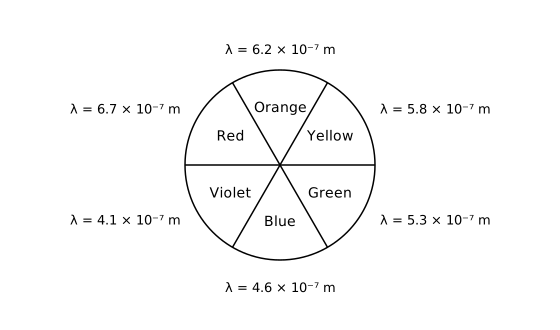
What is correct about the wavelength of light absorbed by [Co(NH3)6]3+ and about the d-orbital splitting caused by NH3 compared with H2O ligands?
A. 4.6 × 10⁻⁷ m; NH3 causes greater splitting than H2O
B. 4.6 × 10⁻⁷ m; NH3 causes smaller splitting than H2O
C. 6.2 × 10⁻⁷ m; NH3 causes greater splitting than H2O
D. 6.2 × 10⁻⁷ m; NH3 causes smaller splitting than H2O
Sprawdź rozwiązanieUkryj rozwiązanieKlucz i punktacja
Odpowiedź z klucza
A ✔
«an orange complex absorbs the complementary colour, blue, at 4.6 × 10⁻⁷ m; the blue aqua complex absorbs orange light at 6.2 × 10⁻⁷ m, a longer wavelength and lower energy; the ammine complex therefore absorbs higher-energy light, so the energy gap between the split d orbitals is larger with NH3 than with H2O»
Schemat punktowania
One mark for the correct option.