Zadanie 1g
Wzorowane na: Chemistry HL Paper 1B, May 2026, TZ2, pytanie 1(g). Treść, dane i kontekst są zmienione; sprawdzane umiejętności, format i punktacja jak w oryginale.
Darmowe konto pozwoli wrócić do niego później.
Informacja do zadań 1a-1h.
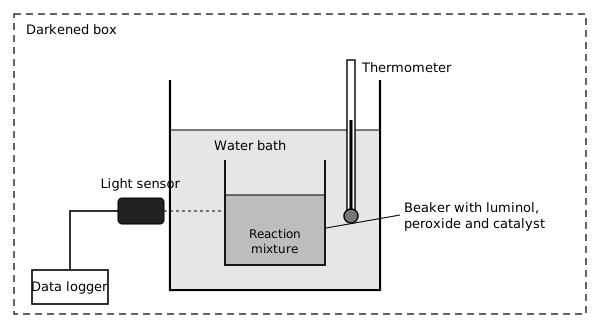
A student investigated how temperature affects the intensity and the duration of the light given out when alkaline luminol solution reacts with hydrogen peroxide in the presence of a catalyst, hexacyanoferrate(III) ions.
Four beakers, each holding 50.0 cm3 of the same alkaline luminol solution, were placed one at a time in a water bath inside a darkened box, the bath being at a different temperature for each run. In every run, 10.0 cm3 of hydrogen peroxide solution and one small crystal of the catalyst were added and the mixture was stirred once. A light sensor beside the beaker recorded the light intensity every 30 seconds for 60 minutes.
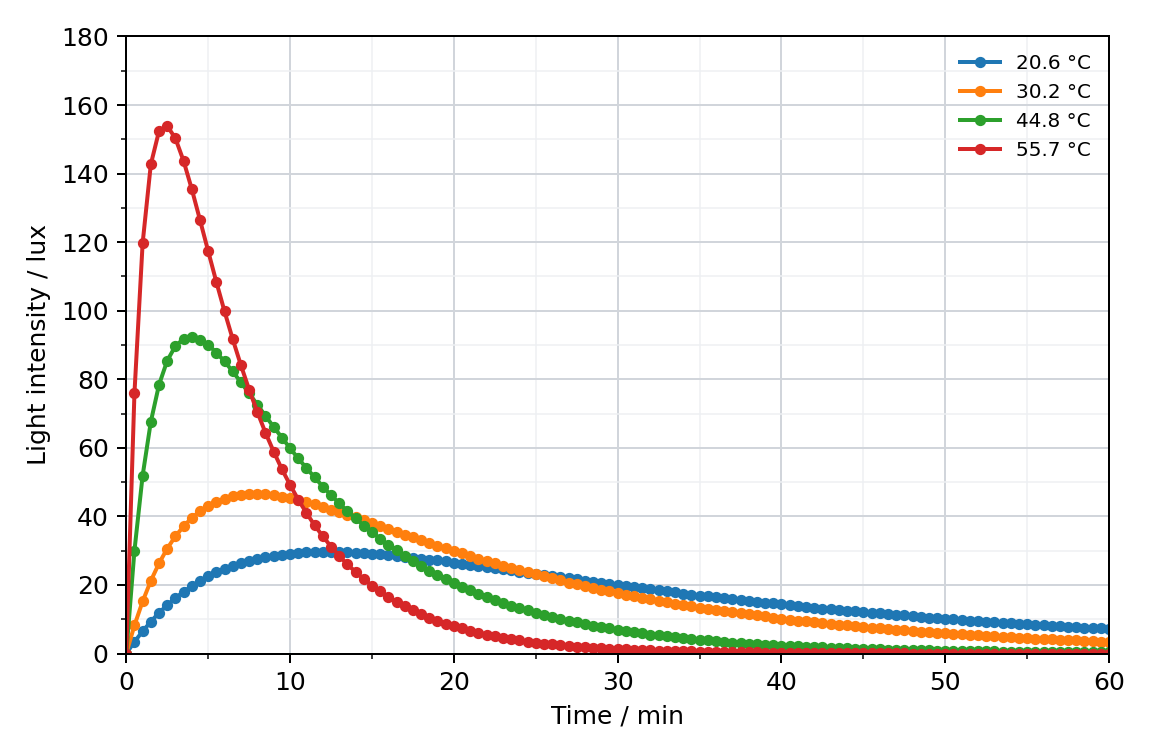
The results are shown on the graph. Each curve is labelled with the temperature of the water bath.
Polecenie
The graph shows the maximum rate of decrease in light intensity for each run, plotted against temperature.
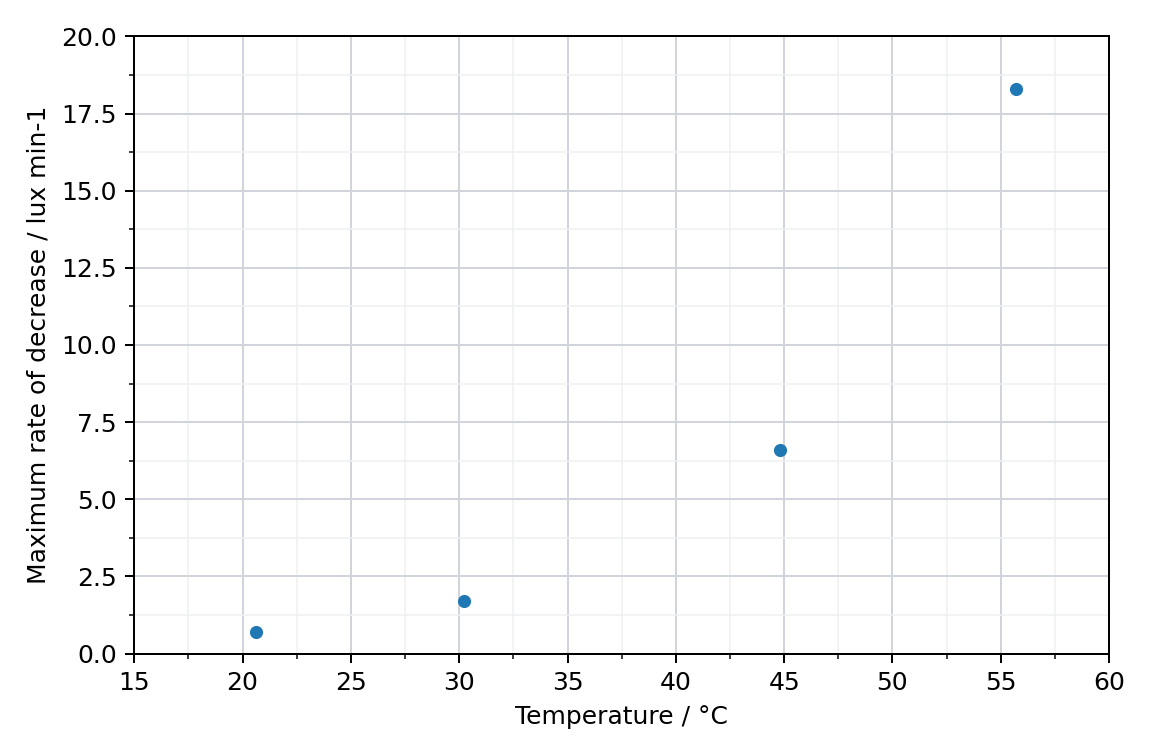
(i) Draw the best-fit curve on the graph.
(ii) Suggest two possible conclusions that can be drawn from the investigation.
Sprawdź rozwiązanieUkryj rozwiązanieKlucz CKE i punktacja
Odpowiedź z klucza
(i) smooth curve of increasing gradient passing close to all four points «not joined dot to dot and not a straight line» ✔
(ii) Any two of:
the maximum rate of decrease in light intensity/the rate of the reaction increases as temperature increases ✔
the peak light intensity is higher at higher temperature ✔
the glow lasts for a shorter time at higher temperature ✔
the rate increases non-linearly/exponentially with temperature, not in direct proportion ✔
Schemat punktowania
(i) [1] for a single smooth curve that follows the trend of the points; a straight line or a dot-to-dot line scores 0. (ii) [2 max], list principle: two different conclusions, each supported by the graphs.
Komentarz
A conclusion must come from the data, so a statement about the time taken for the glow to fade is accepted only if it refers to the curves in the first graph.