Zadanie 1h, Paper 1B, maj 2026, TZ2, Chemia IB HL
Wzorowane na: Chemistry HL Paper 1B, May 2026, TZ2, pytanie 1(h). Treść, dane i kontekst są zmienione; sprawdzane umiejętności, format i punktacja jak w oryginale.
Darmowe konto pozwoli wrócić do niego później.
Zadanie
Wspólne informacje do wiązki zadań
A student investigated how temperature affects the intensity and the duration of the light given out when alkaline luminol solution reacts with hydrogen peroxide in the presence of a catalyst, hexacyanoferrate(III) ions.
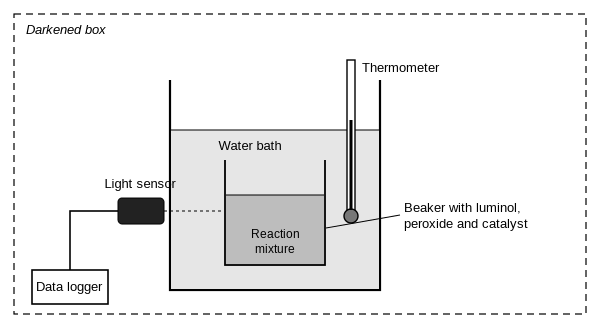
Four beakers, each holding 50.0 cm3 of the same alkaline luminol solution, were placed one at a time in a water bath inside a darkened box, the bath being at a different temperature for each run. In every run, 10.0 cm3 of hydrogen peroxide solution and one small crystal of the catalyst were added and the mixture was stirred once. A light sensor beside the beaker recorded the light intensity every 30 seconds for 60 minutes.
 Powiększ
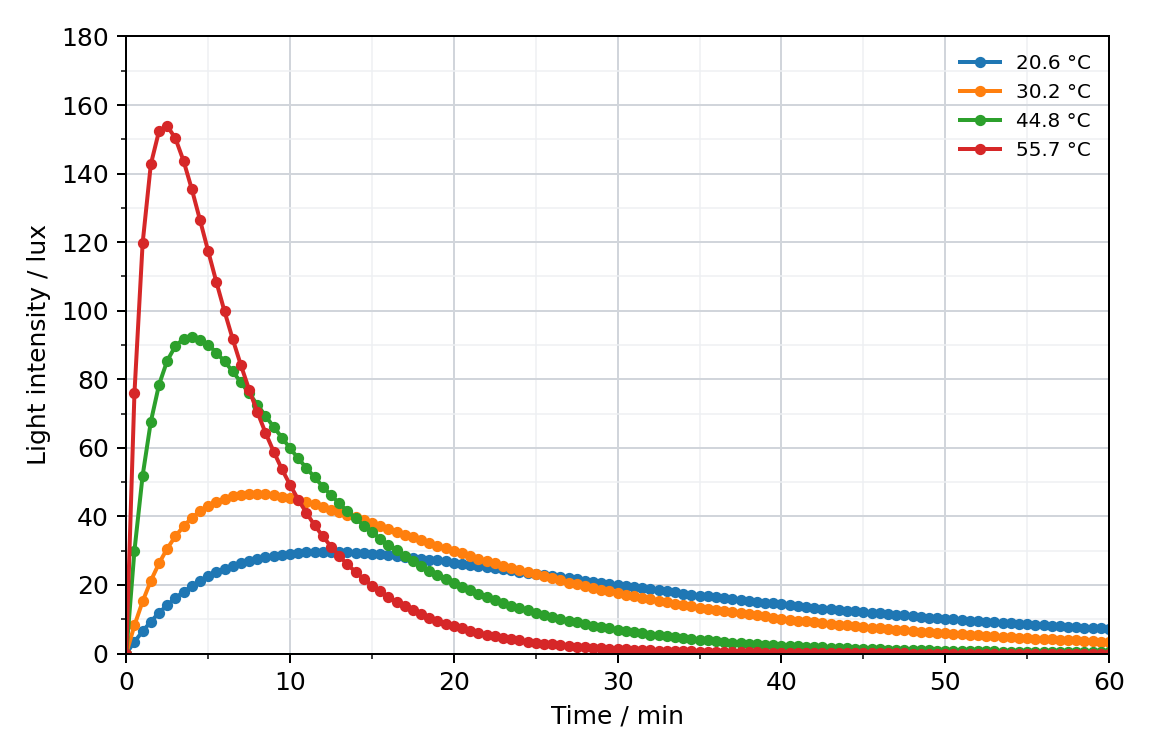
The results are shown on the graph. Each curve is labelled with the temperature of the water bath.
 Powiększ
Polecenie
2 punktySuggest two modifications to the procedure that would make the data more reliable.
Korepetytor
Nie wiesz, jak ruszyć? Korepetytor zna to zadanie i poprowadzi Cię krok po kroku, bez gotowca.
5 rozmów · bez karty · Zaloguj się
Sprawdź się
Jak poszło?
Pokaż rozwiązanieUkryj rozwiązanie
Odpowiedź z klucza
Any two of:
repeat each run several times and use the mean ✔
bring both reagent solutions to the temperature of the bath before mixing ✔
stir for a set time/use a magnetic stirrer so that mixing is the same in every run ✔
use a larger or thermostatically controlled, stirred water bath so that the temperature stays constant ✔
clamp the light sensor at a fixed distance and position ✔
zero the light sensor in the dark before each run ✔
cover the beaker/box to exclude surrounding light ✔
extend the recording until the light intensity has fallen to the baseline in every run ✔
use evenly spaced temperatures ✔
Schemat punktowania
[2 max], list principle. Each modification must improve the quality of the data (repeatability, control of variables or completeness of the record). 'Use a more accurate sensor' alone does not score; accept zeroing/calibrating the sensor before each run.