Zadanie 1b
Wzorowane na: Chemistry SL Paper 3, November 2023, TZ1, pytanie 1(b). Treść, dane i kontekst są zmienione; sprawdzane umiejętności, format i punktacja jak w oryginale.
Darmowe konto pozwoli wrócić do niego później.
Informacja do zadań 1a-1d.
A food chemistry group investigated how the processing and storage of fruit juice affects its vitamin C (ascorbic acid) content.
Polecenie
Ultraviolet (UV) light is being investigated as a way of killing micro-organisms in juice without heating it, so that less vitamin C is lost. The absorption spectrum of a dilute aqueous solution of sorbic acid, a preservative that is added to some bottled juices, was recorded.
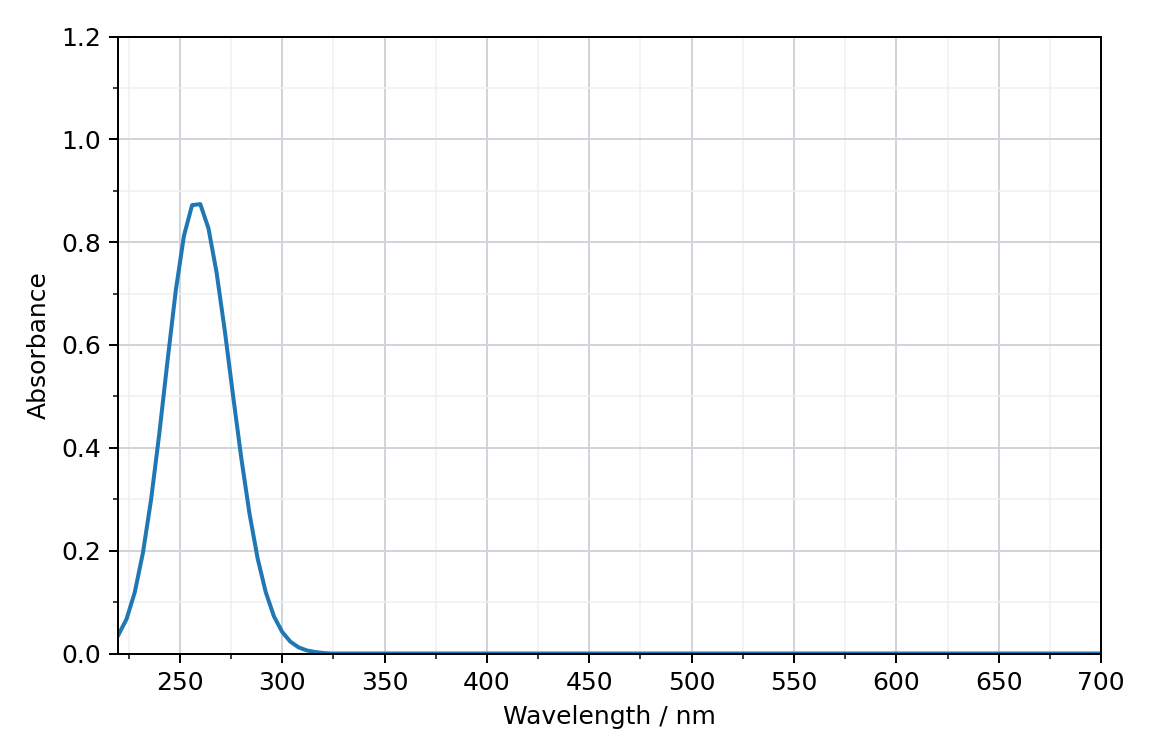
(i) Deduce the region of the electromagnetic spectrum that is absorbed by sorbic acid. Use section 5 of the data booklet.
(ii) Suggest why UV treatment is much less effective at killing micro-organisms in a cloudy, pulpy juice than in clear water.
(iii) Identify two ways of slowing down the oxidation of vitamin C in a bottle of juice during storage.
(iv) Ascorbic acid is also added to bottled apple juice to stop it turning brown through oxidation. Ascorbic acid is very easily oxidized. Outline why this makes it an effective antioxidant.
Sprawdź rozwiązanieUkryj rozwiązanieKlucz i punktacja
Odpowiedź z klucza
(i) UV/ultraviolet ✔
(ii) «UV does not reach the micro-organisms because it is» absorbed by other substances in the juice «sugars, vitamins, pigments, aromatic compounds» OR scattered/blocked by suspended particles/pulp ✔
(iii) Any two of:
store at a lower temperature/in a refrigerator ✔
exclude oxygen/air «seal the bottle completely, fill it to the top, pack under nitrogen or vacuum» ✔
add an antioxidant/reducing agent ✔
store in the dark/in an opaque bottle/limit exposure to light ✔
(iv) it is oxidized in preference to/before the other compounds in the juice «so those compounds are protected»
OR
it is a strong/powerful reducing agent
OR
it gives up electrons more readily than the other compounds in the juice ✔
Schemat punktowania
(i) 1 mark: UV. (ii) 1 mark: UV is absorbed or scattered before it reaches the micro-organisms; do not accept 'UV waves are too small' or arguments about other wavelengths. (iii) 1 mark each for any two different ways; do not accept 'add additives' alone; accept the correct name of an antioxidant. (iv) 1 mark: oxidized first / strong reducing agent / electron donor; 'reacts with oxygen' or 'reacts with oxidizing agents' alone earns nothing, and acid-base explanations are not accepted.
Komentarz
The wavelength of a UV photon is irrelevant to the answer to (ii); what matters is that it is removed from the beam before it reaches the cells.