Zadanie 1b
Wzorowane na: Chemistry SL Paper 3, November 2023, TZ2, pytanie 1(b). Treść, dane i kontekst są zmienione; sprawdzane umiejętności, format i punktacja jak w oryginale.
Darmowe konto pozwoli wrócić do niego później.
Informacja do zadań 1a-1d.
Grapefruit juice is a rich source of vitamin C (ascorbic acid). To destroy pathogenic bacteria, producers often heat-treat the juice by filling it into bottles at 85 °C. A food laboratory monitored the concentration of vitamin C in heat-treated juice and in untreated, cold-pressed juice. Both were stored in partly filled clear glass bottles at 10 °C for 56 days.
Polecenie
UV-C irradiation is an alternative to heat treatment that causes less loss of nutrients. The absorption spectrum of a solution of vitamin C is shown.
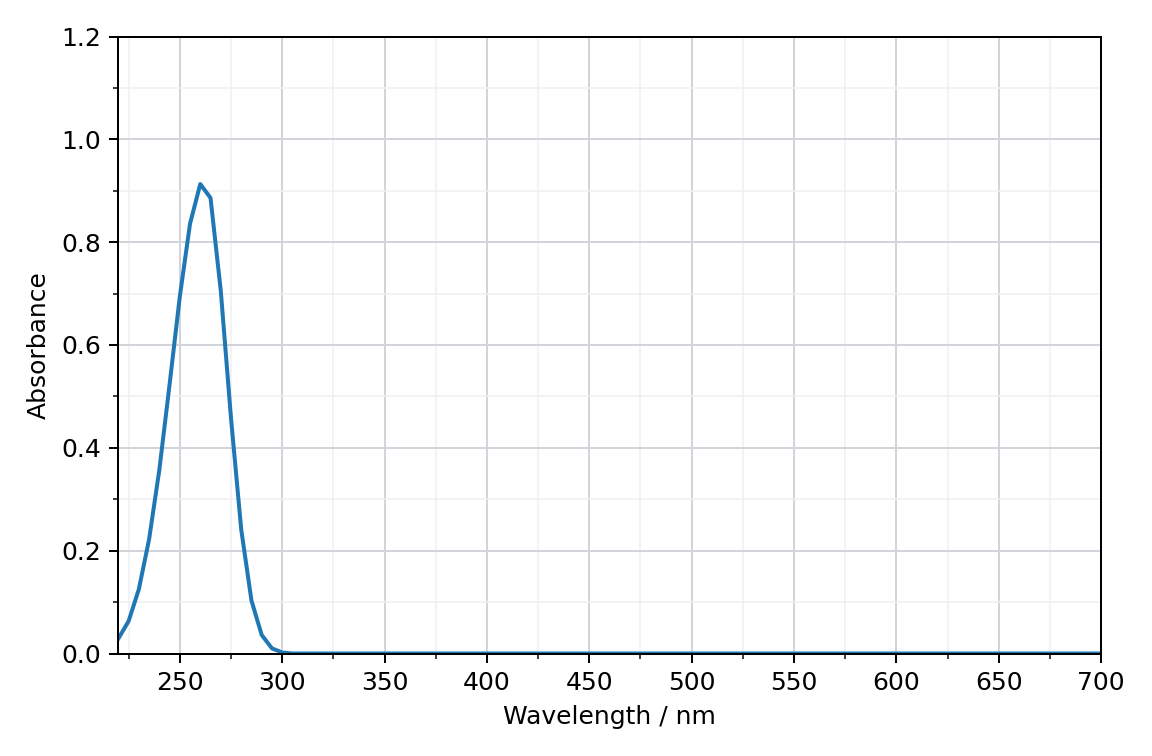
(i) Deduce the type of electromagnetic radiation absorbed by vitamin C. Use section 5 of the data booklet.
(ii) Suggest why UV-C light is not effective for the elimination of pathogenic bacteria in grapefruit juice.
(iii) Identify two ways to decrease the rate at which vitamin C is lost by oxidation during storage of the juice.
(iv) Antioxidants are added to foods and drinks to slow down their spoilage by oxygen. Vitamin C is easily oxidized. Outline why this makes vitamin C an effective antioxidant.
Sprawdź rozwiązanieUkryj rozwiązanieKlucz i punktacja
Odpowiedź z klucza
(i) UV/ultraviolet ✔
(ii) UV-C is absorbed by other substances in the juice «sugars, other vitamins, aromatic compounds, suspended particles» so it does not reach the bacteria
OR
juice is cloudy/not transparent «pulp and oils» so UV-C does not penetrate it ✔
(iii) Any two of:
lower the storage temperature ✔
exclude air/oxygen «seal the bottle, fill it completely, store under nitrogen» ✔
add an antioxidant/reducing agent ✔
store in the dark/in brown bottles/limit exposure to light ✔
(iv) vitamin C is oxidized in preference to the other components of the food or drink «so they are protected»
OR
vitamin C is a strong reducing agent/donates electrons more readily than the other components
OR
vitamin C removes free radicals «by donating electrons» ✔
Schemat punktowania
One mark for each of (i), (ii) and (iv) and two marks for (iii). (ii) Reject answers saying only that UV is too weak or too small to affect bacteria, and answers that argue about a different wavelength. (iii) Do not accept "add additives" alone; accept a named antioxidant. Accept "heat-treat the juice" only if the answer to 1a(iv) was "yes". (iv) Reject "reacts with oxygen" or "reacts with oxidizing agents" on their own, without the idea of preference or of donating electrons; reject acid-base explanations.