Zadanie 4d, Paper 1B, listopad 2025, TZ1, Biologia IB HL
Wzorowane na: Biology HL Paper 1B, November 2025, TZ1, pytanie 4(d). Treść, dane i kontekst są zmienione; sprawdzane umiejętności, format i punktacja jak w oryginale.
Darmowe konto pozwoli wrócić do niego później.
Zadanie
Wspólne informacje do wiązki zadań
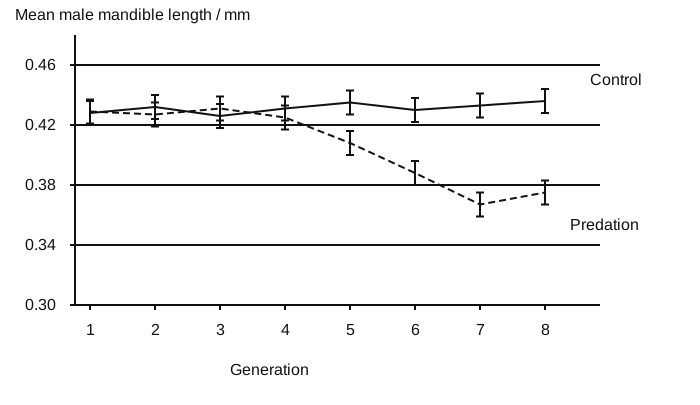
A model laboratory experiment follows a small beetle with variable male mandible length. Four replicate populations experience an insect predator and four controls do not. Mean mandible length and standard-deviation bars are shown over eight generations. Typical mandibles are less than half a millimetre long.
 Powiększ
Polecenie
Explain how predation can produce the observed evolutionary change.
Korepetytor AI
Nie wiesz, jak ruszyć? Korepetytor zna to zadanie i poprowadzi Cię krok po kroku, bez gotowca.
3 rozmowy · bez karty · Zaloguj się
Sprawdź się
Odpowiedz i oceń, jak poszło. Klucz odsłoń dopiero, gdy masz swoją odpowiedź.
Jak poszło Ci z tym zadaniem?
Wybierz ocenę: zapamięta ją ta przeglądarka, a z darmowym kontem zobaczysz ją na każdym urządzeniu.
Pokaż rozwiązanieUkryj rozwiązanieKlucz i punktacja
Odpowiedź z klucza
Mandible length varies among individuals. ✔
Predation is a selection pressure OR smaller mandibles improve escape/survival OR larger mandibles increase capture risk. ✔
Survivors with smaller mandibles have more opportunities to reproduce. ✔
More small-mandibled offspring may be produced than can all survive. ✔
Competition for limited resources favours the better-adapted small-mandibled individuals in this setting. ✔
Alleles contributing to smaller mandibles pass to offspring. ✔
The frequency of these alleles or the small-mandible phenotype increases over generations. ✔
Schemat punktowania
Award any4 distinct points, maximum4. The reproduction point must mention reproduction; the inheritance point concerns alleles. Survival of the fittest without context is insufficient.
Umiejętności w zadaniu
- Inheritance as a requirement for selection responseĆwicz podobne
- Natural selection explaining evolutionary changeĆwicz podobne
- Selection changing allele frequenciesĆwicz podobne
- Relative fitness and reproductive successĆwicz podobne
- Generating the variation available to selectionĆwicz podobne
- Excess offspring and resource competitionĆwicz podobne