Zadanie 2d
Wzorowane na: Chemistry HL Paper 2, May 2026, TZ1, pytanie 2(d). Treść, dane i kontekst są zmienione; sprawdzane umiejętności, format i punktacja jak w oryginale.
Darmowe konto pozwoli wrócić do niego później.
Informacja do zadań 2a-2e.
Rubidium, Rb, is a reactive metal.
Polecenie
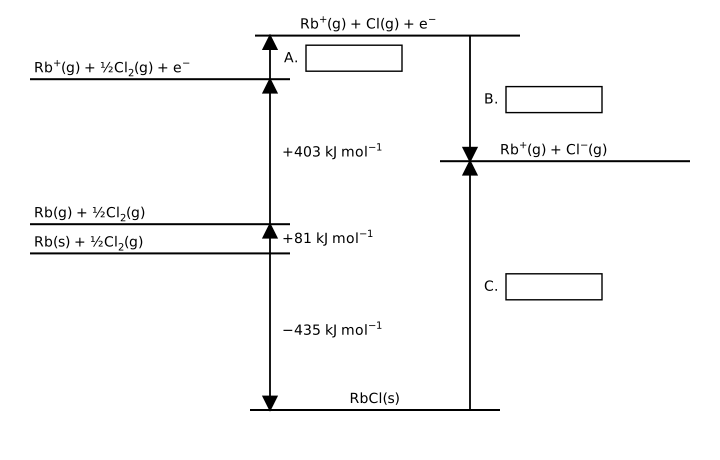
Rubidium also forms compounds with halogens such as chlorine, Cl. Annotate the Born–Haber cycle for rubidium chloride, RbCl, with the correct values in the boxes A, B and C. Use sections 9 and 12 of the data booklet.
Sprawdź rozwiązanieUkryj rozwiązanieKlucz CKE i punktacja
Odpowiedź z klucza
A «bond enthalpy, »: «» +121 «kJ mol−1» ✔
B «electron affinity of chlorine»: −349 «kJ mol−1» ✔
C «lattice enthalpy»: «Hess's law round the cycle: 435 + 81 + 403 + 121 − 349 =» +691 «kJ mol−1» ✔
Schemat punktowania
[3] M1: A = +121 kJ mol-1 (half the Cl–Cl bond enthalpy of 242 kJ mol-1 from section 12); M2: B = −349 kJ mol-1 (electron affinity of Cl from section 9; the negative sign is required); M3: C = +691 kJ mol-1 by Hess's law. Award [3] for 691 kJ mol-1 with or without working. Award [2] for −691 kJ mol-1 for M3 (sign error). Award [2] for +812 kJ mol-1 for M3 (the whole Cl–Cl bond enthalpy used instead of half). Accept 695 kJ mol-1 read directly from section 16 (the experimental value, 4 kJ mol-1 above the value from this cycle) as an alternative for M3. ECF for M3 from A and B as given.
Komentarz
The enthalpy of formation is given as a downward arrow, so the lattice enthalpy (endothermic, upward arrow) must come out positive.