Zadanie 3c
Wzorowane na: Chemistry HL Paper 2, May 2026, TZ1, pytanie 3(c). Treść, dane i kontekst są zmienione; sprawdzane umiejętności, format i punktacja jak w oryginale.
Darmowe konto pozwoli wrócić do niego później.
Informacja do zadań 3a-3d.
Pentane, CH3CH2CH2CH2CH3, is a common fuel.
Polecenie
Pentan-2-ol can form by reacting pent-1-ene with water in the presence of an acid catalyst.
CH2=CHCH2CH2CH3(g) + H2O(l) → CH3CH(OH)CH2CH2CH3(aq) ΔH⊖ = −84 kJ mol−1
(i) The first step of the mechanism for the formation of pentan-2-ol is the protonation of water, H2O + H+ → H3O+. Sketch the mechanism for the remaining steps, from pent-1-ene and H3O+ to pentan-2-ol, using curly arrows.
(ii) Explain why increasing the temperature would increase the rate of this reaction.
(iii) Explain the relative solubility of pentan-2-ol and pent-1-ene in water.
(iv) Pent-1-ene can also form a polymer. Draw a section of the polymer with three repeating units.
(v) Poly(butylene terephthalate), PBT, is a polymer formed by a condensation reaction. A section of the chain is shown.
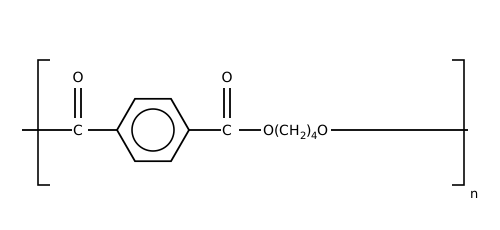
Draw the structural formulas of the two monomers that form PBT.
Sprawdź rozwiązanieUkryj rozwiązanieKlucz CKE i punktacja
Odpowiedź z klucza
(i) Step 2: curly arrow from the C=C double bond to the hydrogen of H3O+ AND a second arrow from the O–H bond to oxygen so that H2O leaves, giving the secondary carbocation CH3CH+CH2CH2CH3 ✔ ✔ ✔
Step 3: curly arrow from a lone pair on the oxygen of H2O to the positively charged carbon, giving the oxonium ion CH3CH(OH2+)CH2CH2CH3 ✔ ✔
Step 4: curly arrow from the O–H bond of the oxonium ion to oxygen AND a lone pair on water (or on the acid anion) taking the proton, giving pentan-2-ol and regenerating H3O+ ✔ ✔
any four of the seven marking points: arrow from C=C to H of H3O+; arrow showing water leaving; structure of the secondary carbocation; arrow from the lone pair on water to the carbocation; structure of the oxonium ion; arrow showing the O–H electrons moving onto oxygen; lone pair from water/acid anion attacking the hydrogen to reform the catalyst
(ii) the frequency of collisions increases «the particles move faster, so more collisions per unit time» ✔
a greater proportion/fraction of the particles has energy ≥ Ea, so a greater proportion of collisions is successful ✔
(iii) pentan-2-ol is more soluble in water than pent-1-ene AND it has an –OH «hydroxyl» group which forms hydrogen bonds with water ✔
pent-1-ene is less soluble/not soluble AND is non-polar/has only London (dispersion) forces ✔
(iv) three repeating units of −CH2−CH(C3H7)− joined by single C–C bonds in one chain, e.g. …CH2−CH(C3H7)−CH2−CH(C3H7)−CH2−CH(C3H7)⋅⋅⋅, with propyl side chains «not methyl», no C=C bonds left and continuation bonds shown at both ends ✔
(v) benzene-1,4-dicarboxylic acid «HOOC−C6H4−COOH, the two acid groups at positions 1 and 4» ✔
butane-1,4-diol «HOCH2CH2CH2CH2OH» ✔
Schemat punktowania
(i) [4] any four of the seven marking points listed in the key; the carbocation must be the secondary one (the product is pentan-2-ol); an arrow must start from a bond or a lone pair and end at an atom; curly arrows may be shown in the structures or described unambiguously. (ii) [2] M1: increased frequency of collisions; a reference to frequency or to time is required, so do not accept "chance" or "probability" without mention of time; M2: increased collision energy, so a greater proportion of collisions are successful, OR a greater fraction of molecules with E ≥ Ea. Do not accept answers about the equilibrium shifting. (iii) [2] M1: pentan-2-ol more soluble AND the –OH (hydroxyl) group forms hydrogen bonds with water; M2: pent-1-ene less/not soluble AND non-polar/only London forces. Do not accept hydroxide for hydroxyl. Award [1] for "pentan-2-ol is polar AND pent-1-ene is non-polar" alone; award [1] for "pentan-2-ol is soluble/more soluble AND pent-1-ene is not/less soluble" alone. (iv) [1] correct repeating unit with the propyl side chain, three units joined, no double bonds, continuation bonds shown; side chains may be drawn on opposite sides or head to tail; penalize missing H atoms once in the paper; ignore square brackets or n; accept a skeletal formula. (v) [2] M1: benzene-1,4-dicarboxylic acid; M2: butane-1,4-diol. Accept skeletal formulas. Accept benzene-1,4-dicarbonyl dichloride (two Cl in place of two OH) for M1, but not for both monomers.
Komentarz
The question is about rate, not equilibrium: the negative ΔH⊖ does not matter for part (ii).