Zadanie 2b, Paper 1B, maj 2025, TZ3, Biologia IB HL
Wzorowane na: Biology HL Paper 1B, May 2025, TZ3, pytanie 2(b). Treść, dane i kontekst są zmienione; sprawdzane umiejętności, format i punktacja jak w oryginale.
Darmowe konto pozwoli wrócić do niego później.
Zadanie
Wspólne informacje do wiązki zadań
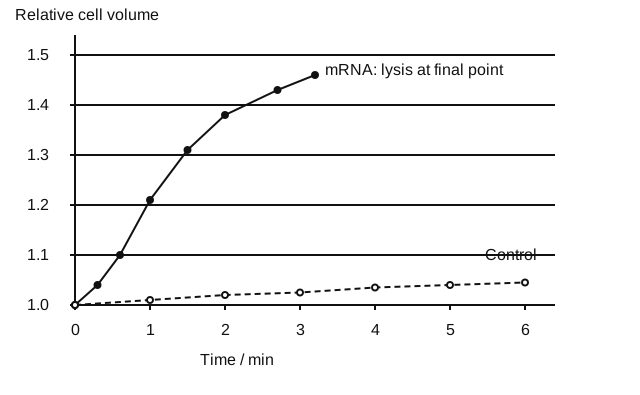
In a constructed replication of an aquaporin experiment, 12 frog oocytes receive mRNA encoding a water-channel protein. Another 12 receive an equal volume of water as a control. After an expression period, all cells are placed in a hypotonic medium. Their initial volumes are used to calculate relative volumes, and group means are plotted.
 Powiększ
Polecenie
(i) Explain why the treated cells and control cells show different changes in volume.
(ii) Discuss how aquaporins in human collecting ducts help when blood water content becomes too low.
Korepetytor AI
Nie wiesz, jak ruszyć? Korepetytor zna to zadanie i poprowadzi Cię krok po kroku, bez gotowca.
3 rozmowy · bez karty · Zaloguj się
Sprawdź się
Odpowiedz i oceń, jak poszło. Klucz odsłoń dopiero, gdy masz swoją odpowiedź.
Jak poszło Ci z tym zadaniem?
Wybierz ocenę: zapamięta ją ta przeglądarka, a z darmowym kontem zobaczysz ją na każdym urządzeniu.
Pokaż rozwiązanieUkryj rozwiązanieKlucz i punktacja
Odpowiedź z klucza
The mRNA-treated cells produce more aquaporins in their membranes. ✔
Water enters by osmosis down a water-potential gradient. ✔
Aquaporin channels increase the membrane permeability to water and speed water entry. ✔
More rapid water gain causes greater swelling and can eventually rupture the cells. ✔
ADH is released from the posterior pituitary. ✔
Aquaporin-containing vesicles deliver their channels to the cell surface. ✔
Additional aquaporins are inserted into the collecting-duct cell membrane. ✔
Water reabsorption into the body increases, helping restore blood water content. ✔
The urine becomes more concentrated. ✔
Schemat punktowania
First part(s): 2 marks. Award any 2 distinct points, maximum 2 marks. Remaining part: maximum 3. Award any 3 points, maximum 3. Smaller urine volume alone does not earn the urine-concentration point. Osmosis OR movement down a water-potential gradient suffices for that transport point. ADH secretion alone earns its point without naming the gland. Increased reabsorption OR increased blood water content suffices for the recovery point.