Zadanie 3a
Wzorowane na: Chemistry HL Paper 2, May 2023, TZ2, pytanie 3(a). Treść, dane i kontekst są zmienione; sprawdzane umiejętności, format i punktacja jak w oryginale.
Darmowe konto pozwoli wrócić do niego później.
Informacja do zadań 3a-3b.
Electrolysis and the Winkler method for dissolved oxygen are both applications of redox reactions.
Polecenie
A dilute aqueous solution of potassium iodide, KI(aq), is electrolysed using inert graphite electrodes, as shown in the diagram.
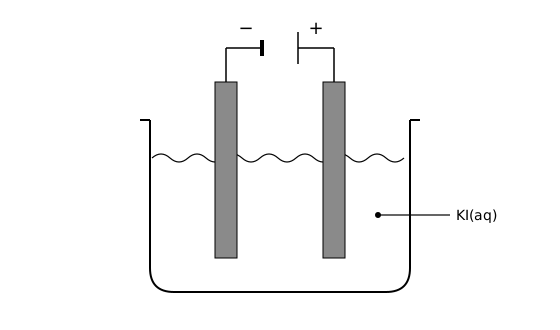
(i) State the direction in which the electrons move in the external circuit, and the direction in which the positive ions and the negative ions move through the solution.
(ii) Deduce the half-equation for the reaction at each electrode. Use section 19 of the data booklet.
(iii) Describe the arrangement of the carbon atoms in graphite and explain why graphite, unlike diamond, conducts electricity.
Sprawdź rozwiązanieUkryj rozwiązanieKlucz i punktacja
Odpowiedź z klucza
(i) electrons flow from the positive electrode to the battery «and from the battery to the negative electrode» ✔
K+ / H+ ions move to the negative electrode AND I− / OH− ions move to the positive electrode ✔
(ii) Positive electrode: 2 I−(aq) → I2(aq) + 2 e− ✔
Negative electrode: 2 H2O(l) + 2 e− → H2(g) + 2 OH−(aq)
OR
2 H+(aq) + 2 e− → H2(g) ✔
(iii) carbon atoms are arranged in layers «hexagonal rings, each carbon bonded to three others in a covalent network within the layer» ✔
each carbon atom has one electron that is delocalized and free to move along the layers, carrying charge «in diamond all four electrons are held in localized bonds» ✔
Schemat punktowania
(i) [1] for the electron direction (through the wire only, not through the solution); [1] for both ion directions, which needs positive ions to the negative electrode and negative ions to the positive electrode. (ii) [1] each. Accept and I2(s). Award [1 max] for correct equations at the wrong electrodes. Ignore state symbols. (iii) [1] for layers; [1] for delocalized / mobile electrons. Accept a suitable diagram for M1.
Komentarz
Water is reduced at the negative electrode because K+ (-2.93 V) is much harder to reduce than water (-0.83 V).