Zadanie 2c
Wzorowane na: Chemistry HL Paper 2, May 2024, TZ1, pytanie 2(c). Treść, dane i kontekst są zmienione; sprawdzane umiejętności, format i punktacja jak w oryginale.
Darmowe konto pozwoli wrócić do niego później.
Informacja do zadań 2a-2c.
A student investigated whether butan-1-ol could be used as a fuel for a small camping stove. The student burned butan-1-ol in a spirit burner placed under a copper calorimeter that contained water.
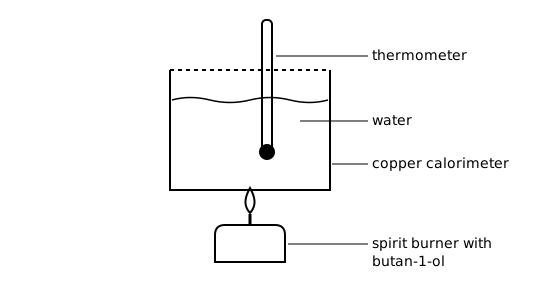
| Measurement | Value |
|---|---|
| Mass of water / g ± 0.02 | 300.00 |
| Initial temperature of water / °C ± 0.5 | 18.5 |
| Final temperature of water / °C ± 0.5 | 38.0 |
| Initial mass of burner and butan-1-ol / g ± 0.01 | 112.46 |
| Final mass of burner and butan-1-ol / g ± 0.01 | 111.11 |
Polecenie
A second spirit burner contains hexane, C6H14, instead of butan-1-ol. Determine whether hexane would release more or less energy per gram than butan-1-ol. Use section 14 of the data booklet.
Sprawdź rozwiązanieUkryj rozwiązanieKlucz i punktacja
Odpowiedź z klucza
butan-1-ol: 1/74.14 = 0.0135 mol in 1 g, so 0.0135 × 2676 = 36.1 «kJ per gram» ✔
hexane: M(C6H14) = 6(12.01) + 14(1.01) = 86.20 g mol−1; 1/86.20 = 0.0116 mol in 1 g, so 0.0116 × 4163 = 48.3 «kJ per gram» ✔
hexane releases more energy per gram ✔
Schemat punktowania
M1: energy per gram of butan-1-ol; M2: energy per gram of hexane; M3: correct conclusion. M3 needs both M1 and M2; positive values are acceptable for M1 and M2.