Zadanie 1b
Wzorowane na: Chemistry HL Paper 3, May 2024, TZ1, pytanie 1(b). Treść, dane i kontekst są zmienione; sprawdzane umiejętności, format i punktacja jak w oryginale.
Darmowe konto pozwoli wrócić do niego później.
Informacja do zadań 1a-1c.
A laboratory investigation uses the oxygen released by aqueous hydrogen peroxide to follow its decomposition.
2 H2O2(aq) → 2 H2O(l) + O2(g)
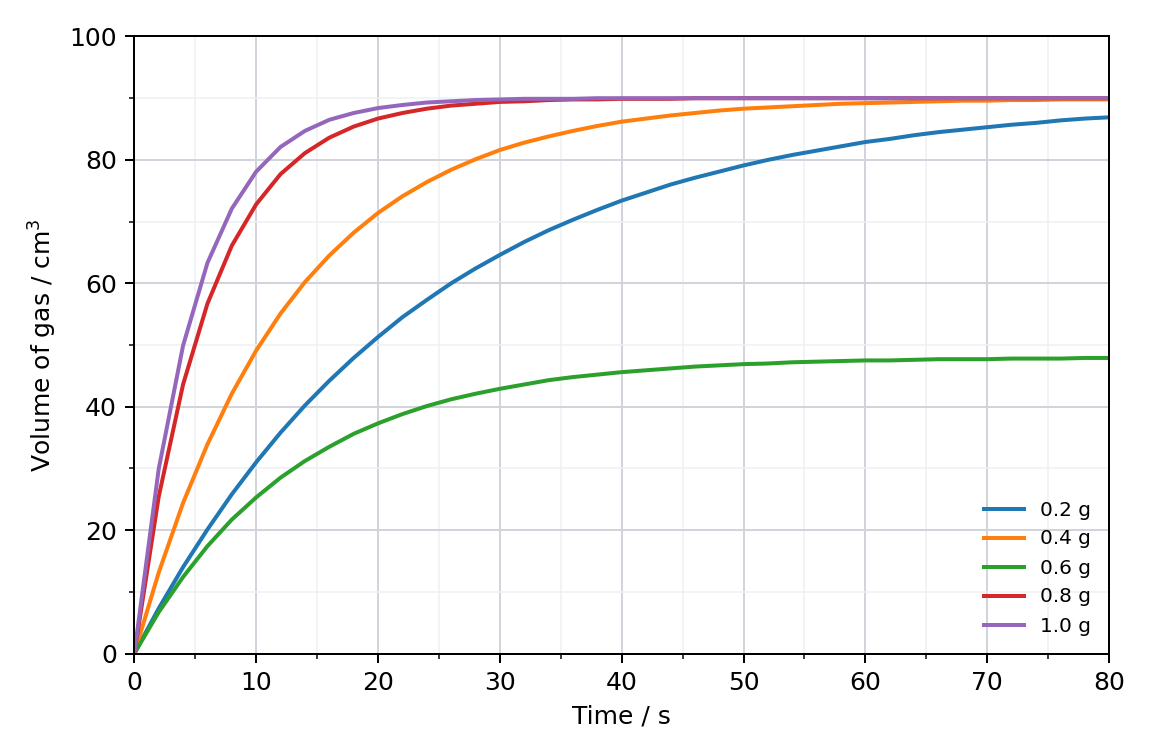
For each run, a weighed portion of copper(II) oxide powder, CuO(s), is mixed with 30.0 cm3 of peroxide solution. A graduated gas syringe collects the oxygen. Readings taken at fixed time intervals give the five curves in Figure 1, each obtained with a different catalyst mass.
Polecenie
The student hypothesized, from theory, that doubling the mass of CuO would double the rate of the catalysed reaction.
(i) Suggest why it is important to state a hypothesis before an experiment is carried out.
(ii) Explain how collision theory could support the student's hypothesis.
(iii) Identify the most important controlled variable that the description of the method does not specify.
Sprawdź rozwiązanieUkryj rozwiązanieKlucz i punktacja
Odpowiedź z klucza
(i) a hypothesis gives a prediction that can be tested «so the experiment can show whether it is supported or rejected»/must be falsifiable ✔
(ii) doubling the mass of solid doubles the surface area available to the reactant ✔
«doubling the surface area» doubles the frequency of collisions «between reactant particles and the catalyst surface» ✔
(iii) temperature
OR
concentration of the hydrogen peroxide solution
OR
particle size/specific surface area of the CuO powder ✔
Schemat punktowania
M1 for (i). M2 and M3 for (ii); accept "increasing" instead of "doubling" in both. Do not accept "greater probability/chance of collisions" for M3. M4 for (iii); do not accept simply "surface area" or the volume of the solution, which is stated.