Zadanie 3a, Paper 1B, maj 2025, TZ3, Chemia IB HL
Wzorowane na: Chemistry HL Paper 1B, May 2025, TZ3, pytanie 3(a). Treść, dane i kontekst są zmienione; sprawdzane umiejętności, format i punktacja jak w oryginale.
Darmowe konto pozwoli wrócić do niego później.
Zadanie
Wspólne informacje do wiązki zadań
Anhydrous copper(II) sulfate is often used as a qualitative test for water, H2O. Hydrated copper(II) sulfate has the formula CuSO4 ⋅ XH2O, where X can be 1, 3, 5 or 7. The hydrated salt is blue and the anhydrous salt is white.
A teacher asked a class to determine the value of X. The students first weighed out 8.000 g of the hydrated salt and left it overnight in a drying oven set to 45 °C. In the morning the crystals were a slightly paler blue than before.
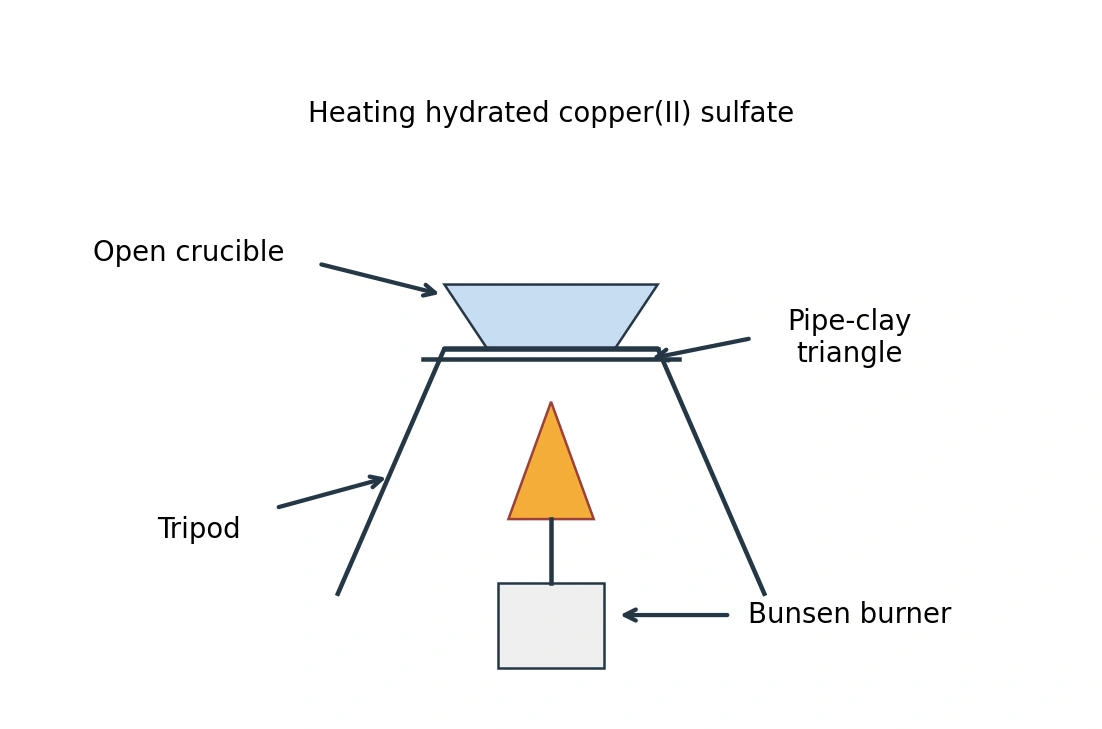
The class then changed the method. Each student heated a known mass of the hydrated salt in an open crucible, supported on a pipe-clay triangle on a tripod over a Bunsen burner, until no further change could be seen, then allowed the crucible to cool and recorded the mass. The process is summarized by the equation:
CuSO4 ⋅ XH2O(s) → CuSO4(s) + XH2O(g)
 Powiększ
Polecenie
(i) Suggest a reason for the slight change in colour observed after the night in the oven.
(ii) Suggest how the students could make sure that dehydration in the crucible was complete.
(iii) Suggest one way in which the students could reduce the effect of systematic error on their values of the change in mass.
Korepetytor AI
Nie wiesz, jak ruszyć? Korepetytor zna to zadanie i poprowadzi Cię krok po kroku, bez gotowca.
3 rozmowy · bez karty · Zaloguj się
Sprawdź się
Odpowiedz i oceń, jak poszło. Klucz odsłoń dopiero, gdy masz swoją odpowiedź.
Zanim porównasz z kluczem
Jak poszło Ci z tym zadaniem?
Zaloguj się, żeby zapisać ocenę i wrócić do zadania później.
Pokaż rozwiązanieUkryj rozwiązanieKlucz i punktacja
Odpowiedź z klucza
(i) only part of the water of crystallization was lost «because 45 °C is too low to remove all of it» ✔
(ii) heat, cool and reweigh repeatedly until the mass no longer changes / heat to constant mass ✔
(iii) allow the crucible to cool completely «to room temperature, in a desiccator» before each weighing ✔
OR
use a balance reading to more decimal places ✔
OR
stir/spread out the solid «or heat without a lid» so that all of the water can escape ✔
Schemat punktowania
(i) [1] for partial loss of water of crystallization, or for the oven temperature being too low to remove all of the water. (ii) [1] for heating to constant mass; 'heat until it is completely white' does not score. (iii) [1] for any one: cooling fully before weighing, a more precise balance, or a change to the heating technique (stirring, spreading the solid out, removing the lid) that makes dehydration complete.
Komentarz. A warm crucible sets up convection currents around the balance pan and reads light, which shifts every mass change in the same direction: a systematic error.