Zadanie 3b, Paper 1B, maj 2025, TZ3, Chemia IB HL
Wzorowane na: Chemistry HL Paper 1B, May 2025, TZ3, pytanie 3(b). Treść, dane i kontekst są zmienione; sprawdzane umiejętności, format i punktacja jak w oryginale.
Darmowe konto pozwoli wrócić do niego później.
Zadanie
Wspólne informacje do wiązki zadań
Anhydrous copper(II) sulfate is often used as a qualitative test for water, H2O. Hydrated copper(II) sulfate has the formula CuSO4 ⋅ XH2O, where X can be 1, 3, 5 or 7. The hydrated salt is blue and the anhydrous salt is white.
A teacher asked a class to determine the value of X. The students first weighed out 8.000 g of the hydrated salt and left it overnight in a drying oven set to 45 °C. In the morning the crystals were a slightly paler blue than before.
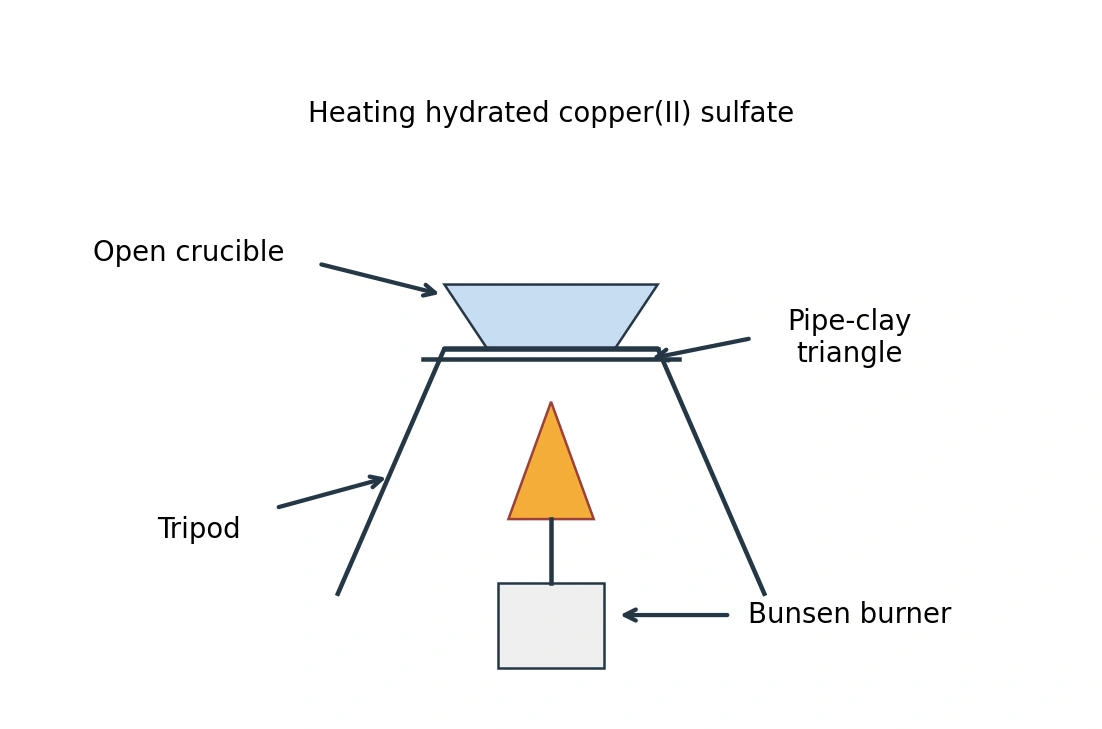
The class then changed the method. Each student heated a known mass of the hydrated salt in an open crucible, supported on a pipe-clay triangle on a tripod over a Bunsen burner, until no further change could be seen, then allowed the crucible to cool and recorded the mass. The process is summarized by the equation:
CuSO4 ⋅ XH2O(s) → CuSO4(s) + XH2O(g)
 Powiększ
Polecenie
Each student used a different mass of the hydrated salt. The results of the whole class are shown below (Mr of H2O = 18.02).
| Student | Mass of CuSO4 ⋅ XH2O / g | Mass of CuSO4 / g | Loss in mass / g | Amount of CuSO4 / mol | Amount of H2O / mol |
|---|---|---|---|---|---|
| 1 | 3.512 | 2.240 | 1.272 | 0.014 | 0.071 |
| 2 | 4.876 | 3.104 | 1.772 | 0.019 | 0.098 |
| 3 | 5.940 | 3.804 | 2.136 | 0.024 | 0.119 |
| 4 | 7.325 | 5.033 | 2.292 | 0.032 | 0.127 |
| 5 | 8.610 | 5.506 | 0.034 | ||
| 6 | 10.245 | 6.538 | 3.707 | 0.041 | 0.206 |
| 7 | 12.130 | 7.712 | 4.418 | 0.048 | 0.245 |
| 8 | 14.770 | 8.780 | 5.990 | 0.055 | 0.332 |
| 9 | 17.905 | 11.381 | 6.524 | 0.071 | 0.362 |
| 10 | 21.360 | 13.642 | 7.718 | 0.085 | 0.428 |
(i) Determine the two missing values in the table.
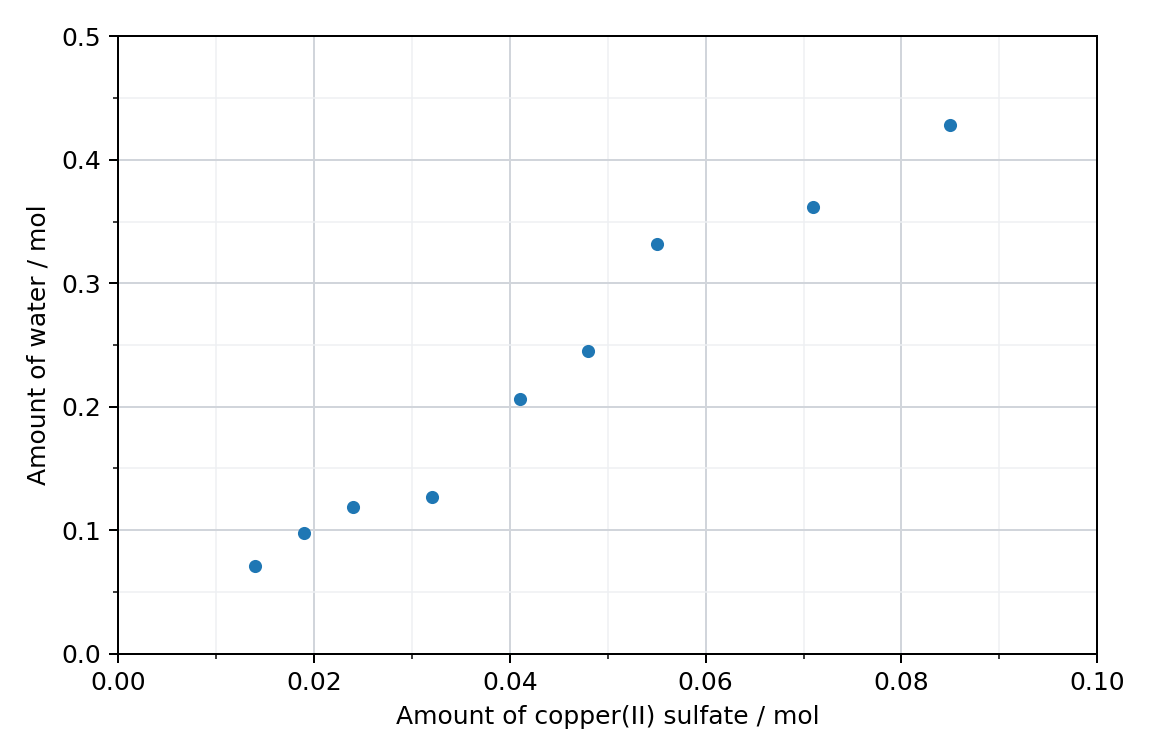
The class results were plotted on the graph below.
 Powiększ
(ii) Draw a line of best fit through the plotted points and extend it until it meets both axes.
(iii) Determine which of the two plotted quantities is the independent variable and which is the dependent variable.
(iv) Suggest, giving a reason, one result on the graph that you consider to be anomalous, and circle that point on the graph.
(v) Determine the value of X.
Korepetytor AI
Nie wiesz, jak ruszyć? Korepetytor zna to zadanie i poprowadzi Cię krok po kroku, bez gotowca.
3 rozmowy · bez karty · Zaloguj się
Sprawdź się
Odpowiedz i oceń, jak poszło. Klucz odsłoń dopiero, gdy masz swoją odpowiedź.
Zanim porównasz z kluczem
Jak poszło Ci z tym zadaniem?
Zaloguj się, żeby zapisać ocenę i wrócić do zadania później.
Pokaż rozwiązanieUkryj rozwiązanieKlucz i punktacja
Odpowiedź z klucza
(i) Loss in mass: «8.610 - 5.506 =» 3.104 g AND amount of H2O: «3.104/18.02 =» 0.172 mol ✔
(ii) ruled straight line passing through or close to most of the points, leaving out the two outliers «students 4 and 8» ✔
line extrapolated so that it passes through the origin ✔
(iii) Independent variable: amount «in mol» of CuSO4 «or mass of hydrated salt» AND Dependent variable: amount «in mol» of H2O ✔
(iv) point for student 4 (0.032, 0.127) circled ✔
Reason: amount of CuSO4 too high OR amount of H2O too low «dehydration was incomplete» ✔
OR
point for student 8 (0.055, 0.332) circled ✔
Reason: amount of CuSO4 too low OR amount of H2O too high «some solid was lost from the crucible» ✔
(v) «X = gradient = =» 5 ✔
Schemat punktowania
(i) [1] for both values to the correct number of figures (three decimal places for the loss, three significant figures for the amount). (ii) M1: line through or close to most of the points and clearly not through the two outliers; M2: line passes through the origin (within half a small division on either axis); award [1 max] for a line obviously not drawn with a ruler. (iii) [1] for both variables; accept mass before heating and mass after heating as the independent and dependent variables. (iv) M1: one of the two anomalous points identified (award M1 even if both are circled; apply the list principle if other points are circled); M2: a reason stating which amount is too high or too low, or its cause (incomplete dehydration, loss of solid); 'it lies far from the line' alone does not score. (v) [1] for X = 5; non-integer values do not score.
Komentarz. The gradient, amount of water per mole of CuSO4, is the number of molecules of water of crystallization; a line that includes the two outliers is pulled away from the true gradient.