Zadanie 1c, Paper 1B, maj 2026, TZ1, Chemia IB HL
Wzorowane na: Chemistry HL Paper 1B, May 2026, TZ1, pytanie 1(c). Treść, dane i kontekst są zmienione; sprawdzane umiejętności, format i punktacja jak w oryginale.
Darmowe konto pozwoli wrócić do niego później.
Zadanie
Wspólne informacje do wiązki zadań
The Salton Sea is a large saline lake in the Colorado Desert, California, USA, whose surface lies below sea level. Its water level has been falling markedly over the last few decades.
Polecenie
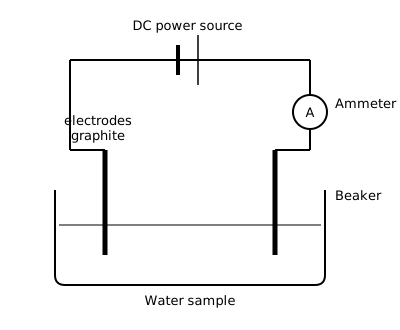
(c) A simple set-up was used to compare the conductivity of water samples obtained from the Salton Sea at different depths.
 Powiększ
The following data were obtained:
| Depth water sample was obtained from / m (±0.05 m) | Electric current recorded by the ammeter / A (±0.01 A) |
|---|---|
| 4.00 | 2.65 |
| 8.00 | 2.72 |
| 12.00 | 3.06 |
| 16.00 | 3.11 |
| 20.00 | 3.15 |
(i) State the independent and the dependent variable in this experiment.
(ii) Suggest two variables, besides temperature, that must be controlled to make a fair comparison of the conductivity of the samples.
(iii) Calculate the fractional uncertainty in the electric current at a depth of 4.00 m. State your answer to the appropriate number of significant figures.
(iv) Suggest a conclusion for the experiment, with an explanation.
(v) Deduce the half-equations for the electrolysis reactions taking place at the cathode and at the anode while the current is flowing. Use section 19 of the data booklet.
Korepetytor AI
Nie wiesz, jak ruszyć? Korepetytor zna to zadanie i poprowadzi Cię krok po kroku, bez gotowca.
3 rozmowy · bez karty · Zaloguj się
Sprawdź się
Odpowiedz i oceń, jak poszło. Klucz odsłoń dopiero, gdy masz swoją odpowiedź.
Zanim porównasz z kluczem
Jak poszło Ci z tym zadaniem?
Zaloguj się, żeby zapisać ocenę i wrócić do zadania później.
Pokaż rozwiązanieUkryj rozwiązanieKlucz i punktacja
Odpowiedź z klucza
(i) independent variable: the depth from which the water sample was obtained ✔
dependent variable: the electric current recorded by the ammeter/the conductivity of the sample ✔
(ii) Any two of:
the potential difference (voltage) of the DC power source ✔
the distance between the two graphite electrodes ✔
the surface area of the electrodes in contact with the sample ✔
the depth to which the electrodes are immersed in the water ✔
(iii) 0.004 «1 significant figure, matching the absolute uncertainty» ✔
(iv) conclusion: as the depth increases, the electric current/conductivity increases ✔
explanation: the water deeper in the lake contains a higher concentration of dissolved ions/salts «the denser, saltier brine settles towards the bottom» ✔
(v) cathode: 2 H2O(l) + 2 e− → H2(g) + 2 OH−(aq) ✔
OR cathode: 2 H+(aq) + 2 e− → H2(g) ✔
anode: 2 Br−(aq) → Br2(aq) + 2 e− ✔
Schemat punktowania
(i) [1] for each variable; accept 'conductivity' or 'reading on the ammeter' for the dependent variable. (ii) [1] each for two different variables from the list; apply the list principle. Accept volume of water/solution, resistance, diameter or length of the wires, cleanliness of the electrode surfaces. 'The water sample' alone is too vague to credit. (iii) [1] for 0.004 «1 significant figure». (iv) M1: the conclusion that the current/conductivity increases with depth; M2: an explanation in terms of a higher concentration of dissolved ions deeper in the lake, consistent with the direction of the trend. (v) [1] for the cathode half-equation (either form) and [1] for the anode half-equation; ignore state symbols. Award [1] if the two equations are correct but assigned to the wrong electrodes. Using section 19: bromide is oxidized in preference to chloride (E for Br2/Br- is less positive than for Cl2/Cl-), and water is reduced in preference to the metal cations present.
Komentarz. Section 19 of the data booklet gives E⊖(Br2/Br−) = +1.09 V against E⊖(Cl2/Cl−) = +1.36 V, so bromide, not chloride, is discharged at the anode even though it is present at a much lower concentration (compare the ion table in 1b).