Zadanie 2b, Paper 2, maj 2026, TZ3, Chemia IB HL
Wzorowane na: Chemistry HL Paper 2, May 2026, TZ3, pytanie 2(b). Treść, dane i kontekst są zmienione; sprawdzane umiejętności, format i punktacja jak w oryginale.
Darmowe konto pozwoli wrócić do niego później.
Zadanie
Wspólne informacje do wiązki zadań
Sulfur dioxide, SO2, is a covalently bonded compound and a common air pollutant released when sulfur-containing fuels burn.
Polecenie
9 punktówThe oxidation of sulfur dioxide to sulfur trioxide is an equilibrium reaction.
2 SO2(g) + O2(g) ⇌ 2 SO3(g)
(i) State the equilibrium constant expression, K, for the reaction.1 punkt
(ii) Explain, with a reason, how compressing the gas mixture at constant temperature will affect the equilibrium position and the value of the equilibrium constant, K.2 punkty
(iii) For a certain reaction, the value of the reaction quotient, Q, was found to be less than the value of the equilibrium constant, K. Explain the difference between Q and K and predict the direction of the spontaneous process for this reaction.2 punkty
(iv) Explain why the rate of the reaction increases when the temperature of the mixture is raised from 700 K to 800 K.2 punkty
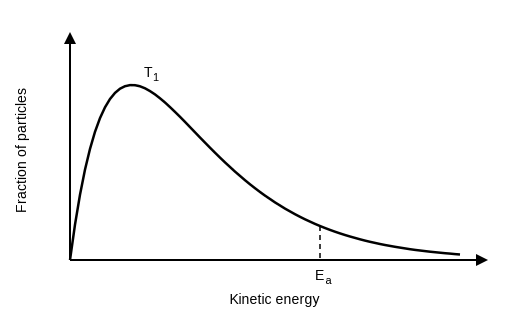
(v) The Maxwell–Boltzmann energy distribution curve for the mixture at temperature T1 is shown below. Sketch a curve at a lower temperature and label it T2.1 punkt
 Powiększ
(vi) State the effect on the activation energy, Ea, of lowering the temperature from T1 to T2.1 punkt
Korepetytor
Nie wiesz, jak ruszyć? Korepetytor zna to zadanie i poprowadzi Cię krok po kroku, bez gotowca.
5 rozmów · bez karty · Zaloguj się
Sprawdź się
Jak poszło?
Pokaż rozwiązanieUkryj rozwiązanie
Odpowiedź z klucza
(i) ✔
(ii) Equilibrium position: shifts to the right / towards the products AND fewer moles of gas on the right-hand side ✔
Value of K: unchanged AND K depends only on temperature ✔
(iii) K is calculated from concentrations at equilibrium AND Q from the same expression but with the concentrations at any other moment ✔
the reaction proceeds to the right / forward AND Q increases until it equals K
OR
the forward reaction is favoured AND reactants are used up and products formed until equilibrium is reached ✔
(iv) a greater proportion of molecules has energy ≥ Ea / the average kinetic energy is higher ✔
more frequent «successful» collisions per unit time
OR
a higher proportion of collisions is successful ✔
(v) curve for T2 starting at the origin AND asymptotic to the x-axis AND with its maximum higher than and to the left of the maximum of T1 ✔
(vi) no effect / unchanged ✔
Schemat punktowania
(i) [1]: square brackets; omit penalty for missing state symbols. (ii) [1] for the position with the reason (fewer gas moles on the right), [1] for K unchanged with the reason; award [1 max] for both effects without reasons. (iii) [1] for the difference between Q and K; [1] for the direction (right / forward) with its reason. (iv) [1] each. (v) [1]: the curve must start at the origin, not touch the axis again, and the peak must be higher and shifted left; the area under the two curves should look equal. (vi) [1].
Komentarz. In part (ii) the pressure is changed by changing the volume, so the position moves; adding an inert gas at constant volume would change nothing.