Zadanie 7b
Wzorowane na: Chemistry SL Paper 3, May 2023, TZ1, pytanie 7(b). Treść, dane i kontekst są zmienione; sprawdzane umiejętności, format i punktacja jak w oryginale.
Darmowe konto pozwoli wrócić do niego później.
Informacja do zadań 7a-7b.
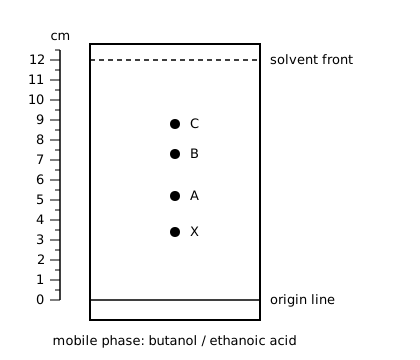
Amino acids can be separated by paper chromatography. A student spotted a mixture of amino acids on the origin line of a strip of chromatography paper and developed the chromatogram with a mixture of butanol and ethanoic acid as the mobile phase. The table gives the RF values of some amino acids in this system.
| Amino acid | RF value |
|---|---|
| Lysine | 0.14 |
| Aspartic acid | 0.24 |
| Asparagine | 0.25 |
| Alanine | 0.38 |
| Proline | 0.43 |
| Valine | 0.61 |
| Phenylalanine | 0.68 |
| Leucine | 0.73 |
The developed chromatogram is shown with a ruler scale in centimetres, whose zero is level with the origin line. Measure to the centre of each spot.
Polecenie
Spot X is known to be either glutamine or isoleucine. The structures of the two amino acids are shown.
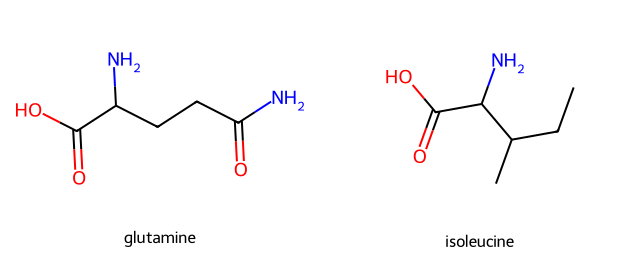
Predict, with reference to the structures, which amino acid is more likely to be in spot X. Use the RF values in the table.
Sprawdź rozwiązanieUkryj rozwiązanieKlucz i punktacja
Odpowiedź z klucza
glutamine AND its side chain is more polar «than that of isoleucine»/has an amide group ✔
forms hydrogen bonds with the stationary phase/has a greater affinity for the stationary phase ✔
OR
less soluble in/weaker affinity for the mobile phase «so moves a shorter distance» ✔
Schemat punktowania
M1: glutamine chosen with a reference to its polar side chain. M2: reasoning in terms of intermolecular forces with the stationary phase or the mobile phase; M2 may be awarded without M1.
Komentarz
Spot X has RF = 3.4/12.0 = 0.28, close to the polar amino acids aspartic acid and asparagine and well below non-polar valine and leucine. The side chain of glutamine can hydrogen bond to the stationary phase; that of isoleucine cannot.