Zadanie 2a
Wzorowane na: Chemistry SL Paper 2, May 2024, TZ1, pytanie 2(a). Treść, dane i kontekst są zmienione; sprawdzane umiejętności, format i punktacja jak w oryginale.
Darmowe konto pozwoli wrócić do niego później.
Informacja do zadań 2a-2b.
A student investigated whether butan-1-ol could be used as a fuel for a small camping stove. The student burned butan-1-ol in a spirit burner placed under a copper calorimeter that contained water.
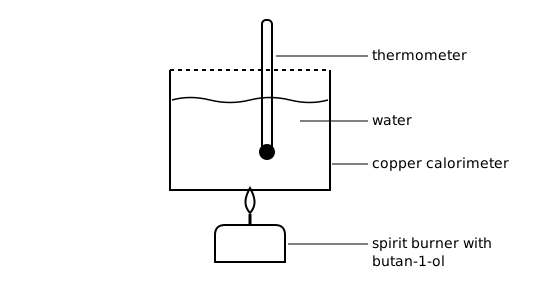
| Measurement | Value |
|---|---|
| Mass of water / g ± 0.02 | 300.00 |
| Initial temperature of water / °C ± 0.5 | 18.5 |
| Final temperature of water / °C ± 0.5 | 38.0 |
| Initial mass of burner and butan-1-ol / g ± 0.01 | 112.46 |
| Final mass of burner and butan-1-ol / g ± 0.01 | 111.11 |
Polecenie
(i) Calculate, in J, the thermal energy gained by the water. Use sections 1 and 2 of the data booklet.
(ii) Determine the percentage uncertainty of the energy value from (i).
(iii) Suggest one way to reduce the effect of random uncertainty on the final result.
Sprawdź rozwiązanieUkryj rozwiązanieKlucz i punktacja
Odpowiedź z klucza
(i) ΔT = 38.0 − 18.5 = 19.5 K
Q = mcΔT = 300.00 × 4.18 × 19.5 = 24 453 J = 24 500 J ✔
(ii) ΔT = 19.5 ± 1.0 K ✔
«» 5.13 % ✔
(iii) repeat the experiment AND calculate the mean ✔
Schemat punktowania
(i) [1]; accept 24.5 kJ. (ii) M1: the uncertainty of the temperature change is ±1.0 K; M2: the two percentage uncertainties are added. Award [2] for a correct final answer; accept 5.13 % (5.1 %) when only the temperature term is used. (iii) [1]; also accept a more precise thermometer or temperature probe, a more precise balance, or a smaller mass of water to give a larger temperature rise. A vague "better apparatus" is not enough, and statements about accuracy do not answer a question on random uncertainty.