Zadanie 2b
Wzorowane na: Chemistry SL Paper 2, May 2024, TZ1, pytanie 2(b). Treść, dane i kontekst są zmienione; sprawdzane umiejętności, format i punktacja jak w oryginale.
Darmowe konto pozwoli wrócić do niego później.
Informacja do zadań 2a-2b.
A student investigated whether butan-1-ol could be used as a fuel for a small camping stove. The student burned butan-1-ol in a spirit burner placed under a copper calorimeter that contained water.
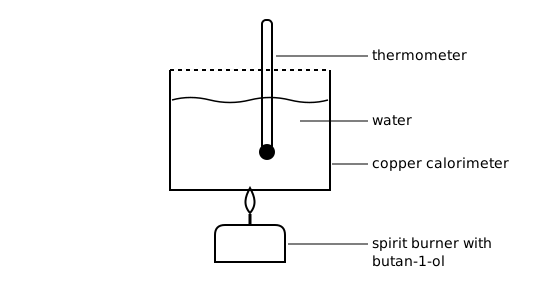
| Measurement | Value |
|---|---|
| Mass of water / g ± 0.02 | 300.00 |
| Initial temperature of water / °C ± 0.5 | 18.5 |
| Final temperature of water / °C ± 0.5 | 38.0 |
| Initial mass of burner and butan-1-ol / g ± 0.01 | 112.46 |
| Final mass of burner and butan-1-ol / g ± 0.01 | 111.11 |
Polecenie
(i) Determine the molar enthalpy of combustion of butan-1-ol, in kJ mol−1, and state one assumption you made.
If you did not obtain an answer to 2a(i), use 20 000 J, but this is not the correct value.
(ii) Calculate the percentage error of your enthalpy value, using the literature value in section 14 of the data booklet.
(iii) Identify the largest source of error in this experiment and suggest one improvement that would reduce it.
Sprawdź rozwiązanieUkryj rozwiązanieKlucz i punktacja
Odpowiedź z klucza
(i) M(C4H9OH) = 4(12.01) + 10(1.01) + 16.00 = 74.14 g mol−1
mass of butan-1-ol burned = 112.46 − 111.11 = 1.35 g, so n = 1.35/74.14 = 0.0182 «mol» ✔
ΔHc = −24.45/0.01821 = −1343 «kJ mol−1, about −1340» ✔
assumption «any one»: all the heat released by the burning fuel is absorbed by the water / no heat is lost to the surroundings / the copper calorimeter absorbs no heat / the combustion is complete / the fuel is pure butan-1-ol ✔
(ii) «» 49.8 «%» ✔
(iii) heat loss «to the surroundings» AND insulate the calorimeter / use a draught shield / reduce the distance between the flame and the calorimeter ✔
Schemat punktowania
(i) M1: amount of butan-1-ol; M2: enthalpy change, only awarded for a negative (exothermic) value; accept −1340 to −1350 kJ mol−1. If 20 000 J is used: −1100 kJ mol−1 (−1098). M3: one correct assumption. (ii) [1]; ignore the sign; accept 49.8 to 50 %; if 20 000 J was used, 59 %. (iii) [1]; accept "heat loss AND a lid or closed system with a low heat capacity calorimeter". A lid on its own is not sufficient, and replacing the copper calorimeter by a polystyrene cup is not an acceptable improvement.