Zadanie 1c
Wzorowane na: Chemistry SL Paper 1B, May 2026, TZ3, pytanie 1(c). Treść, dane i kontekst są zmienione; sprawdzane umiejętności, format i punktacja jak w oryginale.
Darmowe konto pozwoli wrócić do niego później.
Informacja do zadań 1a-1c.
A student investigated the reaction between aqueous nitric acid, HNO3, and solid magnesium carbonate, MgCO3, using two different methods to follow its rate.
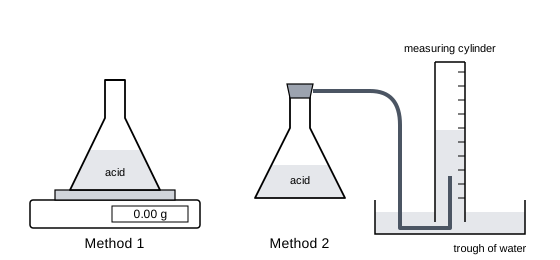
In Method 1, a conical flask containing the aqueous acid stood on a balance and the mass reading was recorded at regular intervals while the gas escaped from the open flask. In Method 2, the flask was closed with a stopper carrying a delivery tube; the gas passed through the tube into an inverted measuring cylinder filled with water and standing in a trough of water, and the volume of gas collected was recorded at regular intervals.
Polecenie
The student repeated the experiment using Method 2, with the same quantities of acid and solid.
(i) Calculate the volume of gas that will have collected in the measuring cylinder once the reaction has finished, measured at T = 22 °C and P = 1.00 × 10⁵ Pa. Use section 1 of the data booklet and your answer to part 1a(iii). If you have no answer to part 1a(iii), use 0.150 g, which is not the correct value.
(ii) The time at which each 10 cm3 of gas had been collected was recorded, and the experiment was carried out three times. The raw data are plotted below.
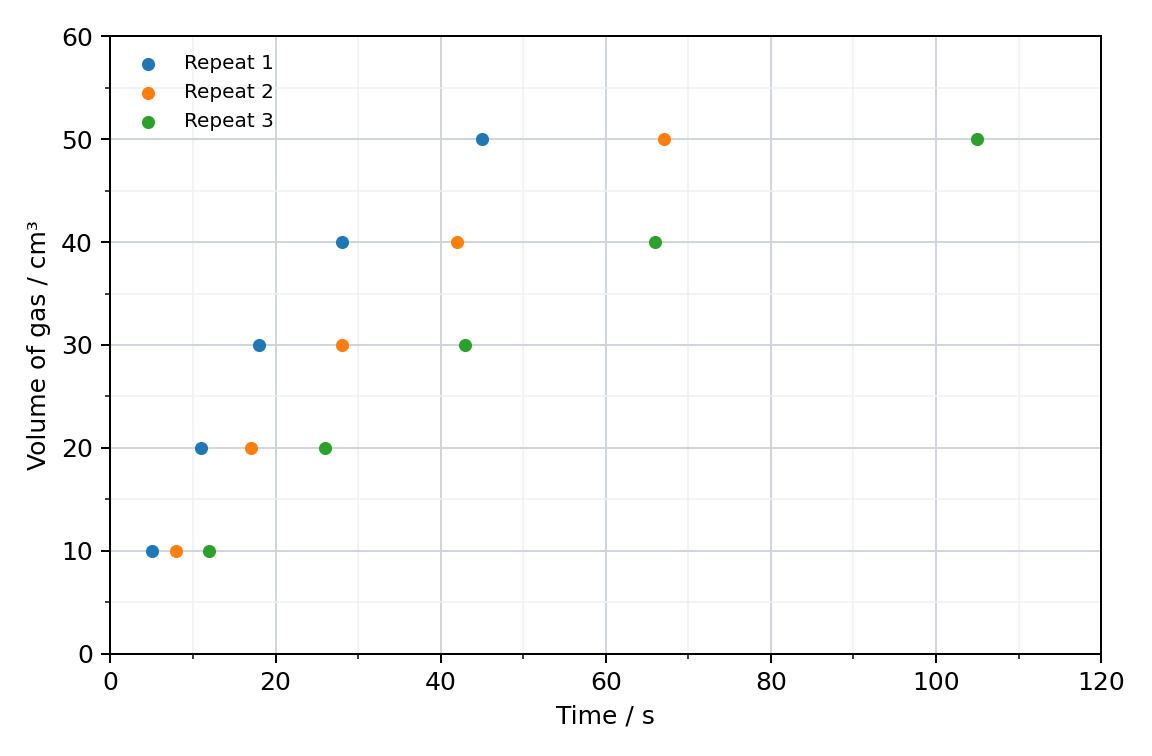
Suggest which of the two methods gives the more precise results, giving a reason that refers to the graph in part 1b and the graph above.
(iii) Identify the type of error that makes the less precise method less precise and give one likely cause of it.
Sprawdź rozwiązanieUkryj rozwiązanieKlucz CKE i punktacja
Odpowiedź z klucza
(i) T = 295 / 295.15 «K» ✔
«n(CO2) = n(MgCO3) = 2.5 × 10⁻³ mol»
« =» 0.0613 «dm3» ✔
OR
« =» 6.13 × 10⁻⁵ «m3»
(ii) Method 1 «is more precise» AND the uncertainty «of the mean values» is small / the error bars are too small to be seen ✔
OR
Method 1 AND the three repeats of Method 2 are not concordant / differ widely / are not reproducible ✔
(iii) «random error» AND any one cause, for example:
the time taken to fit the stopper differs from run to run, so a different amount of gas escapes before collection starts
OR froth / bubbles / trapped air in the measuring cylinder make the volume hard to read
OR uncertainty in reading the volume at the meniscus / in the timing
OR a different amount of gas lost by dissolving in the water of the trough in each run
OR spray carried out of the flask by vigorous effervescence ✔
Schemat punktowania
(i) [2]: M1 temperature in kelvin; M2 volume consistent with the units stated (0.0613 dm3, 61.3 cm3 or 6.13 × 10⁻⁵ m3). Award [2] for the correct final answer; accept 0.0610 to 0.0614 dm3 (61.0 to 61.4 cm3). Do not award M2 if the volume is inconsistent with the unit given. Award [1 max] for 0.0567 or 0.0568 dm3 (the volume at STP). Award [2] for 0.0436 dm3 if 0.150 g was used. (ii) [1] for Method 1 with a reason based on the small uncertainty in Method 1 or the inconsistent repeats in Method 2. (iii) [1] for a valid reason; the name given to the type of error is not needed for the mark. Do not accept gas leaking from the apparatus other than while the stopper is being fitted.
Komentarz
The 0.0613 dm3 is the volume if all the gas is collected; the measured volume is lower if some of the carbon dioxide dissolves in the water or escapes while the stopper is fitted.