Zadanie 1a
Wzorowane na: Chemistry HL Paper 2, November 2024, pytanie 1(a). Treść, dane i kontekst są zmienione; sprawdzane umiejętności, format i punktacja jak w oryginale.
Darmowe konto pozwoli wrócić do niego później.
Polecenie
The graph shows the boiling points of the straight-chain alkenes with a terminal double bond, from ethene to hex-1-ene.
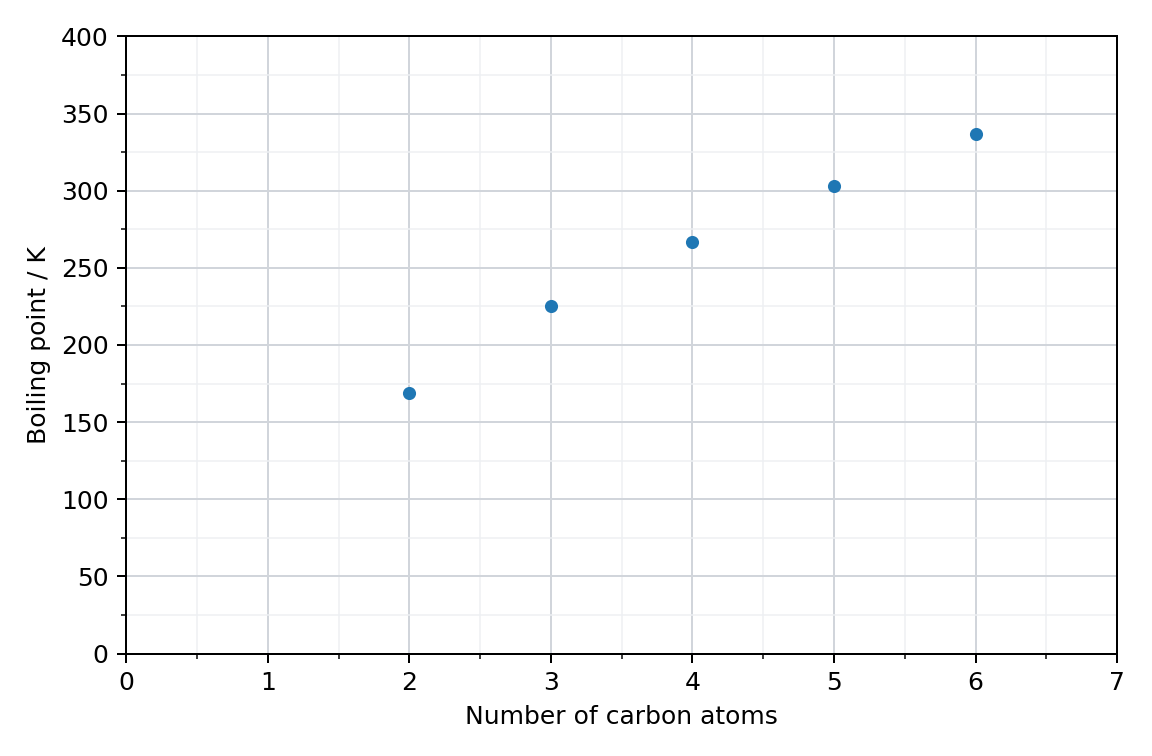
(i) Explain why the boiling point rises from ethene to but-1-ene.
(ii) A sample of but-1-ene is warmed from 250 K to 300 K at constant pressure. Explain why its volume increases very sharply over this range.
(iii) A sample of ethene gas has a mass of 7.30 g and is at 100 kPa and 20 °C. Calculate its volume, in dm3.
(iv) Outline why, at very high pressure, the measured volume of ethene is larger than the volume predicted by PV = nRT.
Sprawdź rozwiązanieUkryj rozwiązanieKlucz i punktacja
Odpowiedź z klucza
(i) London (dispersion) forces «only» ✔
strength of the London forces increases as the number of electrons / size of the electron cloud / molar mass increases ✔
(ii) the but-1-ene boils / vaporizes «its boiling point, about 267 K, lies between 250 K and 300 K» ✔
gaseous molecules are much further apart than in the liquid ✔
(iii) «M(C2H4) = 28.06 g mol−1»
= 0.260 «mol» ✔
= 6.33 «dm3» ✔
(iv) at very high pressure ethene deviates from ideal behaviour / is a real gas ✔
the molecules themselves take up a significant fraction of the total volume «the ideal gas model treats them as points» ✔
Schemat punktowania
(i) M1: London (dispersion) forces; M2: strength increases with more electrons or larger size. For M2 an answer in terms of stronger intermolecular forces between heavier molecules is also fine. (ii) M1: a change of state from liquid to gas (M2 cannot be earned without M1); M2: molecules much further apart, or gas much less dense. (iii) M1: amount of ethene; M2: volume. Award [2] for a correct final answer in the range 6.33-6.34 dm3; accept T = 293.15 K. (iv) M1: real gas, not ideal; M2: volume of the molecules not negligible.