Zadanie 2a, Paper 1B, listopad 2025, TZ3, Chemia IB HL
Wzorowane na: Chemistry HL Paper 1B, November 2025, TZ3, pytanie 2(a). Treść, dane i kontekst są zmienione; sprawdzane umiejętności, format i punktacja jak w oryginale.
Darmowe konto pozwoli wrócić do niego później.
Zadanie
Wspólne informacje do wiązki zadań
Two students were asked to determine the concentration of a solution of potassium hydroxide, KOH, by thermometric titration with 2.40 mol dm−3 nitric acid, HNO3, using a thermometer and the glassware available in the school laboratory. Both solutions were at 20 °C at the start.
Student A measured out the two solutions with a 50 cm3 measuring cylinder, combining them in a 150 cm3 glass beaker to give eleven mixtures, each with a total volume of 40.0 cm3, and the highest temperature of every mixture was recorded.
| Volume of HNO3 ± 0.5 / cm3 | Volume of KOH ± 0.5 / cm3 | Highest temperature ± 1 / °C |
|---|---|---|
| 0.0 | 40.0 | 20 |
| 4.0 | 36.0 | 23 |
| 8.0 | 32.0 | 27 |
| 12.0 | 28.0 | 30 |
| 16.0 | 24.0 | 32 |
| 20.0 | 20.0 | 32 |
| 24.0 | 16.0 | 30 |
| 28.0 | 12.0 | 27 |
| 32.0 | 8.0 | 25 |
| 36.0 | 4.0 | 22 |
| 40.0 | 0.0 | 20 |
Polecenie
(i) Suggest one hazard to health or safety in Student A's procedure.
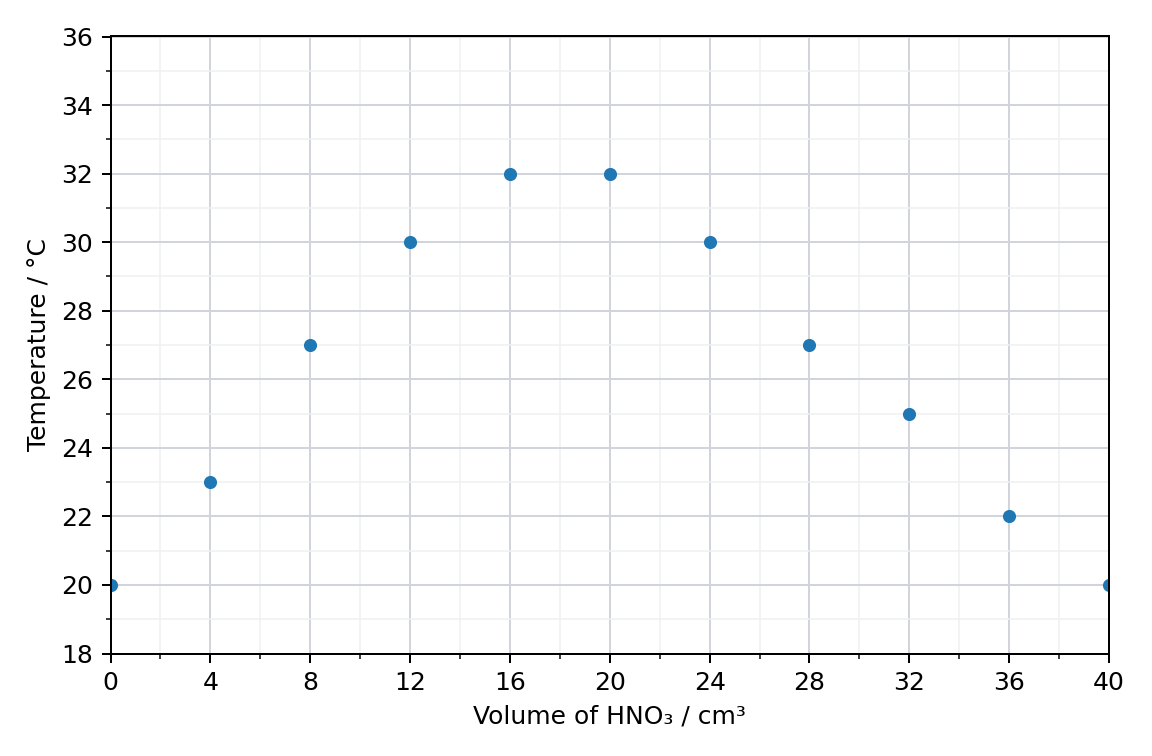
(ii) Student A plotted the highest temperature of each mixture against the volume of nitric acid.
 Powiększ
With a ruler, draw two straight lines of best fit: one following the rising set of points and the other following the falling set, then extend both until they meet.
(iii) In the mixtures where nitric acid is the limiting reactant, the enthalpy change of neutralization, ΔH, in kJ mol−1, can be found from the temperature rise, ΔT, and the volume, V, in cm3, of nitric acid in the mixture:
Based on the precision of the thermometer, determine the percentage uncertainty in the largest temperature rise that Student A recorded.
(iv) State two conditions that must be true for the expression in part (iii) to give a valid enthalpy change of neutralization.
Korepetytor AI
Nie wiesz, jak ruszyć? Korepetytor zna to zadanie i poprowadzi Cię krok po kroku, bez gotowca.
3 rozmowy · bez karty · Zaloguj się
Sprawdź się
Odpowiedz i oceń, jak poszło. Klucz odsłoń dopiero, gdy masz swoją odpowiedź.
Zanim porównasz z kluczem
Jak poszło Ci z tym zadaniem?
Zaloguj się, żeby zapisać ocenę i wrócić do zadania później.
Pokaż rozwiązanieUkryj rozwiązanieKlucz i punktacja
Odpowiedź z klucza
(i) nitric acid / potassium hydroxide solution is corrosive «and can burn the skin or damage the eyes» ✔
OR
the glass beaker / thermometer may break «and cut the skin» ✔
(ii) two straight lines drawn with a ruler: the rising line through «or close to» the points from 0.0 to 12.0 cm3 and the falling line through the points from 20.0 to 40.0 cm3, both extended until they cross «at about 17 cm3 and 34 °C» ✔
(iii) uncertainty in ΔT = «±»2 «°C» ✔
percentage uncertainty = « =» 17 «%» ✔
(iv) Any two of:
the specific heat capacity of the mixture is equal to that of water / 4.18 «J g−1 K−1» ✔
the density of the mixture is 1.00 «g cm−3» / 40.0 cm3 of mixture has a mass of 40.0 g ✔
no heat is lost to the surroundings / the heat capacity of the beaker and thermometer is negligible ✔
the reaction goes to completion / all the nitric acid reacts ✔
Schemat punktowania
(i) [1] for any specific hazard: corrosive acid or alkali (accept 'burns' or 'irritates the skin or eyes'), broken glass, hot liquid. (ii) [1] for both lines passing close to their data points, not through the point at 16.0 cm3, and extended to the intersection; accept a rising line that takes the 16.0 cm3 point into account but passes above it; lines that are not straight or are obviously drawn without a ruler score zero. On screen, accept a description of the intersection, or its coordinates (about 17 cm3 and 34 °C), in place of drawn lines. (iii) M1: ±2 °C (two readings, each ±1 °C); M2: 17 % (accept 16.7 %, and 14 to 17 % if the temperature rise is read from the intersection of the lines). Award [2] for a correct final answer. (iv) [1] for each assumption, [2 max].
Komentarz. The uncertainty in a temperature difference is the sum of the uncertainties of the two readings, so ±1 °C on each reading gives ±2 °C on ΔT; the percentage is taken of the rise, not of the final temperature.