Zadanie 3c, Paper 1B, maj 2025, TZ2, Chemia IB HL
Wzorowane na: Chemistry HL Paper 1B, May 2025, TZ2, pytanie 3(c). Treść, dane i kontekst są zmienione; sprawdzane umiejętności, format i punktacja jak w oryginale.
Darmowe konto pozwoli wrócić do niego później.
Zadanie
Wspólne informacje do wiązki zadań
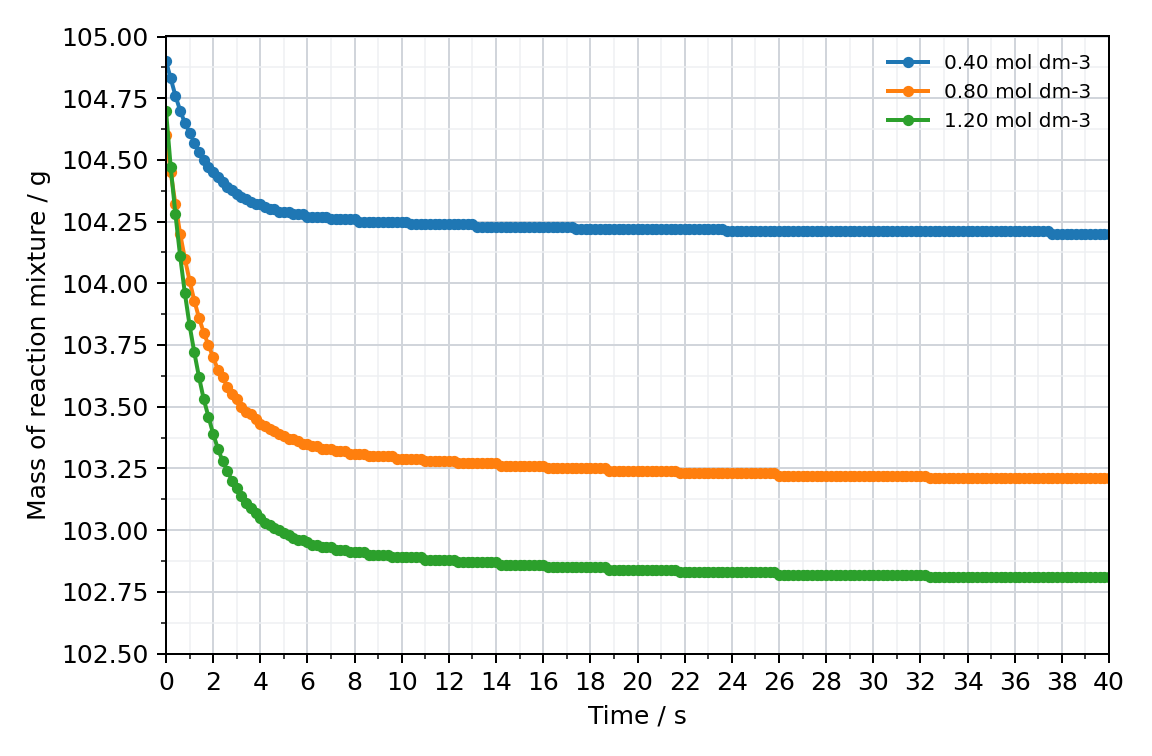
The reaction between powdered calcium carbonate, CaCO3(s), and dilute nitric acid, HNO3(aq), was followed by measuring the loss of mass. In each run the same mass of powder was added to the same volume of acid; three acid concentrations were used. The flask stood on a balance connected to a data logger, which recorded the mass of the reaction mixture every 0.2 seconds for 40 seconds.
CaCO3(s) + 2 HNO3(aq) → Ca(NO3)2(aq) + CO2(g) + H2O(l)
The results were plotted on the graph.
 Powiększ
Polecenie
If the reaction with 0.80 mol dm−3 HNO3(aq) went to completion, the theoretical mass of CO2(g) released would be 1.76 g.
(i) Use the graph to determine the mass, in g, of CO2(g) actually released in this reaction.
(ii) Calculate the percentage difference between the actual mass of CO2(g) and the theoretical mass, relative to the theoretical mass.
(iii) The same mass of CaCO3(s) and the same volume of HNO3(aq) were used in every run, yet the three curves start at different masses. Suggest an error in the procedure that could account for the different starting masses.
Korepetytor AI
Nie wiesz, jak ruszyć? Korepetytor zna to zadanie i poprowadzi Cię krok po kroku, bez gotowca.
3 rozmowy · bez karty · Zaloguj się
Sprawdź się
Odpowiedz i oceń, jak poszło. Klucz odsłoń dopiero, gdy masz swoją odpowiedź.
Zanim porównasz z kluczem
Jak poszło Ci z tym zadaniem?
Zaloguj się, żeby zapisać ocenę i wrócić do zadania później.
Pokaż rozwiązanieUkryj rozwiązanieKlucz i punktacja
Odpowiedź z klucza
(i) «104.6 − 103.2 =» 1.4 «g» ✔
(ii) «» 20 «%» ✔
(iii) Any one of:
the data logger was started after the solid had been added, so some CO2 had already escaped/the delay before recording differed between runs ✔
the balance was not tared/zeroed in the same way before each run ✔
different flasks «with slightly different masses» were used ✔
the flask was wet/not cleaned between runs ✔
not all of the solid or acid was transferred to the flask ✔
the volume of acid was measured with a measuring cylinder «so it varied slightly» ✔
the balance drifted/was recalibrated between runs ✔
Schemat punktowania
(i) [1] for 1.3 to 1.5 g. (ii) [1]; ECF from (i): 1.3 g gives 26 %, 1.5 g gives 15 %; accept 20 % or 20.5 %. (iii) [1], list principle.
Komentarz. The percentage difference is taken relative to the theoretical value; the missing mass is CO2 that dissolved in the solution or escaped before logging started.