Zadanie 14, Paper 1A, listopad 2025, TZ1, Chemia IB SL
Wzorowane na: Chemistry SL Paper 1A, November 2025, TZ1, pytanie 14. Treść, dane i kontekst są zmienione; sprawdzane umiejętności, format i punktacja jak w oryginale.
Darmowe konto pozwoli wrócić do niego później.
Zadanie
Polecenie
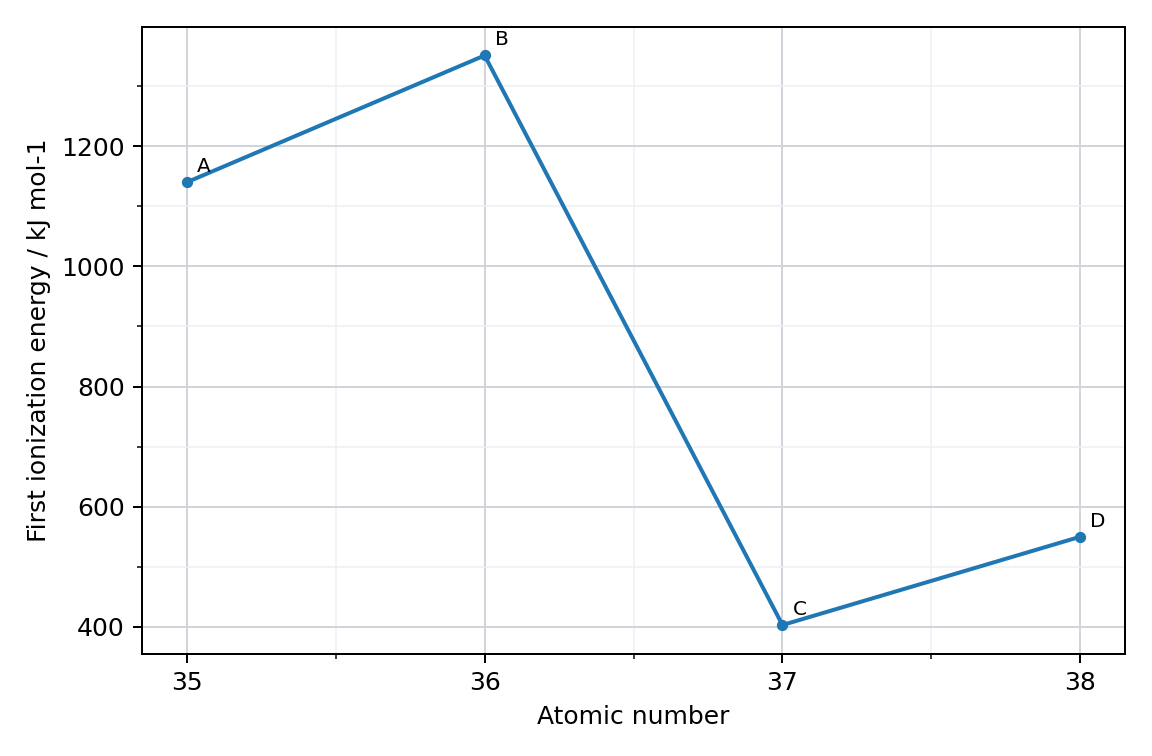
The first ionization energies of four elements with consecutive atomic numbers, A, B, C and D, are shown.
 Powiększ
An element X reacts with oxygen to form an acidic oxide.
Which element could be X?
- AA
- BB
- CC
- DD
Korepetytor AI
Nie wiesz, jak ruszyć? Korepetytor zna to zadanie i poprowadzi Cię krok po kroku, bez gotowca.
3 rozmowy · bez karty · Zaloguj się
Sprawdź się
Odpowiedz i oceń, jak poszło. Klucz odsłoń dopiero, gdy masz swoją odpowiedź.
Sprawdź odpowiedź w aplikacji
To zadanie sprawdza się automatycznie według klucza. Z darmowym kontem zaznaczysz odpowiedź tutaj i od razu zobaczysz wynik.
Załóż konto i sprawdź odpowiedźZanim porównasz z kluczem
Jak poszło Ci z tym zadaniem?
Zaloguj się, żeby zapisać ocenę i wrócić do zadania później.
Pokaż rozwiązanieUkryj rozwiązanieKlucz i punktacja
Odpowiedź z klucza
A ✔
«the four consecutive atomic numbers 35-38 are bromine, krypton, rubidium and strontium: the first ionization energy rises from the halogen (A) to the noble gas (B), then drops sharply at the start of a new period to the alkali metal (C) and rises slightly to the alkaline earth metal (D). A non-metal such as bromine forms an acidic oxide when it reacts with oxygen; the noble gas B does not react with oxygen; the metals C and D form basic oxides»
Schemat punktowania
One mark for the correct option.
Komentarz. The exact identity of the elements is not required: the shape of the graph (rise to a peak, then a sharp drop at a new period) is enough to place a non-metal at A, a noble gas at B and two metals at C and D.