Zadanie 3a, Paper 1B, maj 2025, TZ2, Chemia IB SL
Wzorowane na: Chemistry SL Paper 1B, May 2025, TZ2, pytanie 3(a). Treść, dane i kontekst są zmienione; sprawdzane umiejętności, format i punktacja jak w oryginale.
Darmowe konto pozwoli wrócić do niego później.
Zadanie
Wspólne informacje do wiązki zadań
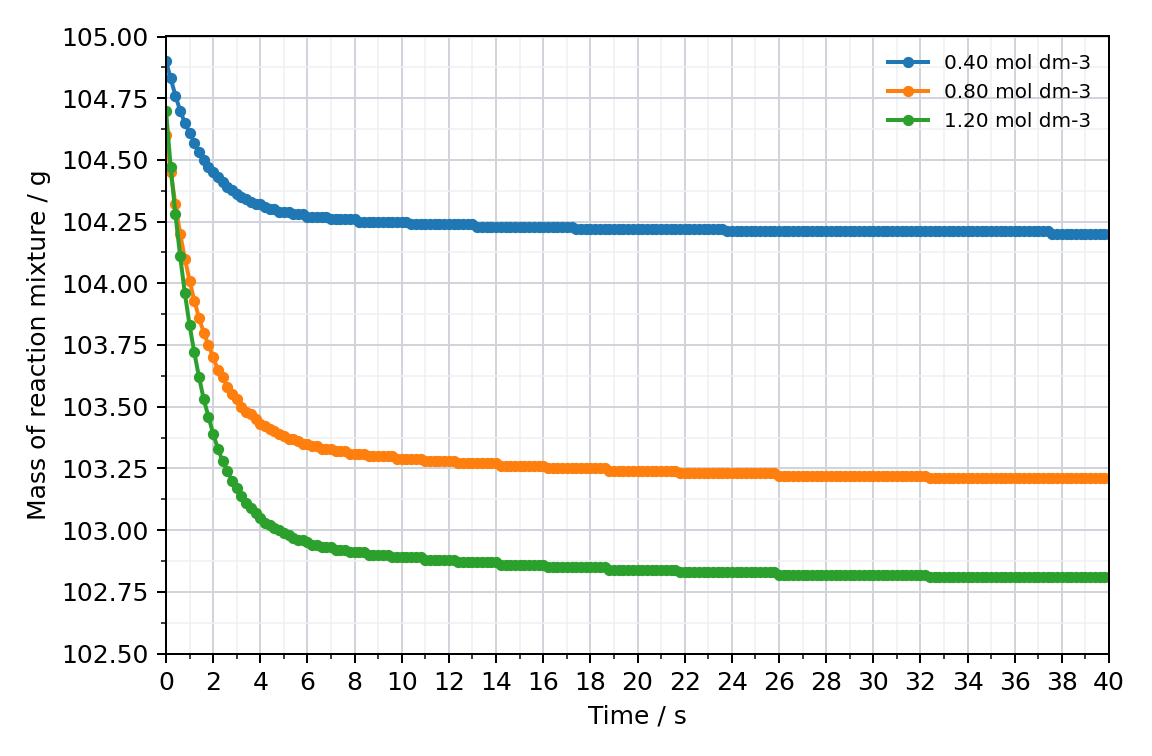
The reaction between powdered calcium carbonate, CaCO3(s), and dilute nitric acid, HNO3(aq), was followed by measuring the loss of mass. In each run the same mass of powder was added to the same volume of acid; three acid concentrations were used. The flask stood on a balance connected to a data logger, which recorded the mass of the reaction mixture every 0.2 seconds for 40 seconds.
CaCO3(s) + 2 HNO3(aq) → Ca(NO3)2(aq) + CO2(g) + H2O(l)
The results were plotted on the graph.
 Powiększ
Polecenie
(i) Determine, using a suitable construction drawn on the graph, the initial rate at which CO2(g) is released, in g s−1, in the reaction with 1.20 mol dm−3 HNO3(aq).
(ii) Determine the average rate of release of CO2(g), in g s−1, in the reaction with 0.40 mol dm−3 HNO3(aq) over the first 20 seconds.
Korepetytor AI
Nie wiesz, jak ruszyć? Korepetytor zna to zadanie i poprowadzi Cię krok po kroku, bez gotowca.
3 rozmowy · bez karty · Zaloguj się
Sprawdź się
Odpowiedz i oceń, jak poszło. Klucz odsłoń dopiero, gdy masz swoją odpowiedź.
Zanim porównasz z kluczem
Jak poszło Ci z tym zadaniem?
Zaloguj się, żeby zapisać ocenę i wrócić do zadania później.
Pokaż rozwiązanieUkryj rozwiązanieKlucz i punktacja
Odpowiedź z klucza
(i) tangent drawn to the 1.20 mol dm−3 curve at t = 0 ✔
gradient of the tangent calculated and the rate quoted as a positive value: «for example » 1.2 «g s−1» ✔
(ii) «∣ 104.90 − 104.22 ∣ /20 =» 0.034 «g s−1» ✔
Schemat punktowania
(i) M1: a tangent at t = 0 on the correct curve; M1 is required for M2. M2: gradient from two points on the tangent, given as a positive rate; accept 1.0 to 1.4 g s-1. A gradient taken between two data points on the curve, or a negative value, does not score M2. (ii) [1] for 0.034 g s−1 (accept 0.030 to 0.040 g s−1), from the masses at t = 0 and t = 20 s on the 0.40 mol dm−3 curve; the sign must be positive.
Komentarz. The mass of the mixture decreases, but the rate of release of the gas is reported as a positive number equal to the magnitude of the gradient.