Zadanie 1b, Paper 2, maj 2025, TZ2, Chemia IB HL
Wzorowane na: Chemistry HL Paper 2, May 2025, TZ2, pytanie 1(b). Treść, dane i kontekst są zmienione; sprawdzane umiejętności, format i punktacja jak w oryginale.
Darmowe konto pozwoli wrócić do niego później.
Zadanie
Wspólne informacje do wiązki zadań
Hydrogen cyanide, HCN, is an extremely poisonous compound that is nevertheless manufactured on a large scale, because it is a starting material for polymers such as nylon and poly(methyl methacrylate).
Polecenie
In aqueous solution hydrogen cyanide behaves as a weak acid.
(i) Write an equation for the ionization of hydrogen cyanide in water.
(ii) Outline two ways in which a solution of 0.050 mol dm−3 HCN could be distinguished experimentally from a solution of 0.050 mol dm−3 hydrobromic acid, HBr.
(iii) Calculate the pH of a 0.160 mol dm−3 solution of HCN, given that Ka = 6.25 × 10⁻¹⁰ at this temperature.
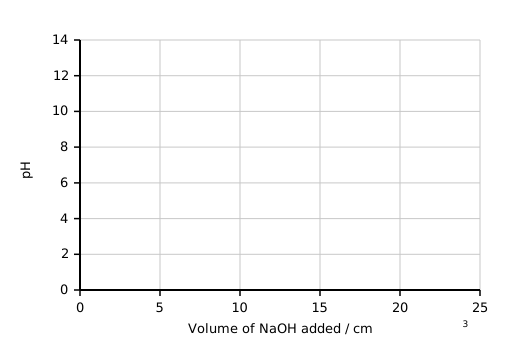
(iv) Sketch, on the axes below, how the pH changes when 25.0 cm3 of 0.250 mol dm−3 sodium hydroxide solution is added a little at a time to 25.0 cm3 of 0.160 mol dm−3 HCN.
 Powiększ
(v) Deduce where on your sketch the solution consists of NaCN(aq) alone, and mark this point with the label "Salt".
(vi) The enthalpy of neutralization of HCN by NaOH is −12.1 kJ mol−1. Calculate the rise in temperature that occurs when 25.0 cm3 of 0.250 mol dm−3 NaOH is mixed with 25.0 cm3 of 0.160 mol dm−3 HCN. Use sections 1 and 2 of the data booklet.
Korepetytor AI
Nie wiesz, jak ruszyć? Korepetytor zna to zadanie i poprowadzi Cię krok po kroku, bez gotowca.
3 rozmowy · bez karty · Zaloguj się
Sprawdź się
Odpowiedz i oceń, jak poszło. Klucz odsłoń dopiero, gdy masz swoją odpowiedź.
Zanim porównasz z kluczem
Jak poszło Ci z tym zadaniem?
Zaloguj się, żeby zapisać ocenę i wrócić do zadania później.
Pokaż rozwiązanieUkryj rozwiązanieKlucz i punktacja
Odpowiedź z klucza
(i) HCN(aq) ⇌ H+(aq) + CN−(aq) ✔
OR
HCN(aq) + H2O(l) ⇌ H3O+(aq) + CN−(aq) ✔
(ii) Any two of:
measure the pH «with a meter or universal indicator» AND the HCN solution has the higher pH ✔
measure the electrical conductivity AND the HCN solution is the poorer conductor ✔
add a reactive metal / a metal carbonate / magnesium AND the HCN solution reacts more slowly «fewer bubbles per second» ✔
titrate with a strong base AND the HCN titration has an equivalence point above pH 7 / a smaller temperature rise ✔
(iii) «mol dm−3» ✔
pH «= −log10(1.00 × 10⁻⁵)» = 5.00 ✔
(iv) sigmoidal curve AND equivalence point above pH 7 ✔
curve starts between pH 4 and 6 «pH 5.0, from (iii)» AND finishes between pH 11 and 14 «about 12.7» ✔
steep, almost vertical rise at 16.0 cm3 «n(HCN) = 0.0250 × 0.160 = 4.00 × 10⁻³ mol, V = 4.00 × 10⁻³/0.250» ✔
(v) equivalence point «on the vertical section at 16.0 cm3» labelled "Salt" ✔
(vi) amount neutralized «= n(HCN) = 0.0250 × 0.160» = 4.00 × 10⁻³ mol «HCN is limiting; n(NaOH) = 6.25 × 10⁻³ mol» ✔
= 0.232 «K / °C» ✔
Schemat punktowania
(i) [1] either equation with the equilibrium arrow. (ii) [2 max] one mark per method together with its observation; award [1] for two correct methods without observations; answers must refer to rates, not amounts. (iii) [2] M1 [H+]; M2 pH; award [2] for a correct final answer. (iv) [3] M1 shape and equivalence pH above 7; M2 starting and finishing pH; M3 vertical section at 16.0 cm3. (v) [1] the label at the equivalence point of the student's own curve. (vi) [2] M1 amount of HCN neutralized; M2 temperature rise; award [2] for a correct final answer; ECF from M1.
Komentarz. In (vi) the acid is the limiting reactant, so the excess 2.25 × 10^-3 mol of NaOH releases no heat, while the whole 50.0 g of solution is warmed.