Zadanie 3c, Paper 2, maj 2025, TZ2, Chemia IB HL
Wzorowane na: Chemistry HL Paper 2, May 2025, TZ2, pytanie 3(c). Treść, dane i kontekst są zmienione; sprawdzane umiejętności, format i punktacja jak w oryginale.
Darmowe konto pozwoli wrócić do niego później.
Zadanie
Wspólne informacje do wiązki zadań
Carbonyl dibromide, Br2CO, is a reactive compound used as a brominating agent in organic synthesis.
Polecenie
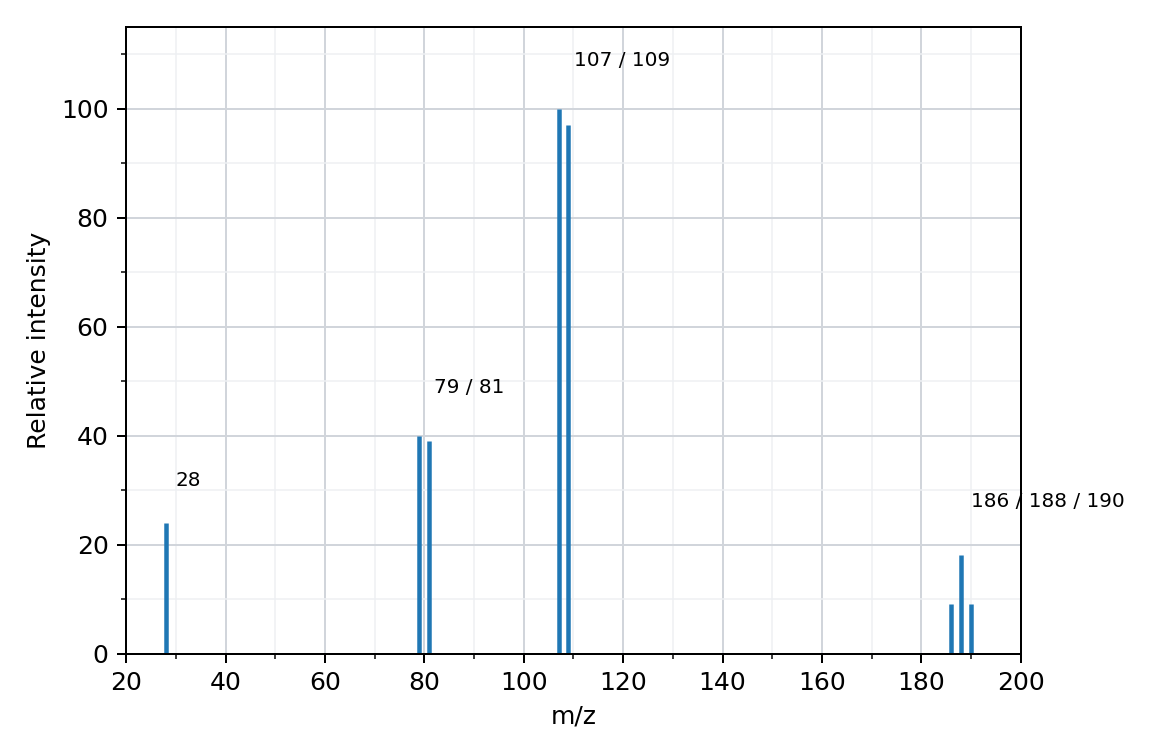
The mass spectrum of carbonyl dibromide is shown below. Bromine has two isotopes, and , of almost equal abundance.
 Powiększ
(i) Explain the origin of the peaks that appear at m/z values smaller than those of the molecular ion.
(ii) Deduce the formula of the species responsible for the peak at m/z = 107.
(iii) Predict what the IR spectrum and the NMR spectrum of carbonyl dibromide would show. Use section 20 of the data booklet.
Korepetytor AI
Nie wiesz, jak ruszyć? Korepetytor zna to zadanie i poprowadzi Cię krok po kroku, bez gotowca.
3 rozmowy · bez karty · Zaloguj się
Sprawdź się
Odpowiedz i oceń, jak poszło. Klucz odsłoń dopiero, gdy masz swoją odpowiedź.
Zanim porównasz z kluczem
Jak poszło Ci z tym zadaniem?
Zaloguj się, żeby zapisać ocenę i wrócić do zadania później.
Pokaż rozwiązanieUkryj rozwiązanieKlucz i punktacja
Odpowiedź z klucza
(i) the molecular ion fragments «breaks up after ionization in the spectrometer» ✔
(ii) [COBr]+ / Br−C≡O+ «containing » ✔
(iii) IR: strong absorption at 1700–1750 cm−1 due to C=O
OR
strong absorption at 500–600 cm−1 due to C−Br ✔
NMR: no signal, because the molecule contains no hydrogen atoms ✔
Schemat punktowania
(i) [1] fragmentation; accept 'the molecule is unstable and breaks apart on ionization'. (ii) [1] the positive charge must be shown; 12 + 16 + 79 = 107. (iii) [2] M1 one IR absorption with its wavenumber range from section 20; M2 no 1H NMR signal with the reason.
Komentarz. The molecular ion appears as three peaks (186, 188, 190) in a 1:2:1 ratio because each bromine atom can be 79Br or 81Br; the fragment [COBr]+ gives a 1:1 pair at 107 and 109.