Zadanie 2d, Paper 1B, specimen 2025, Chemia IB HL
Wzorowane na: Chemistry HL Paper 1B, specimen 2025, pytanie 2(d). Treść, dane i kontekst są zmienione; sprawdzane umiejętności, format i punktacja jak w oryginale.
Darmowe konto pozwoli wrócić do niego później.
Zadanie
Wspólne informacje do wiązki zadań
Sulfur dioxide, SO2, is added as a preservative to many fruit cordials (concentrated fruit drinks that are diluted before drinking). In the acidic cordial it is present mainly as hydrogensulfite ions, HSO3−(aq), which are slowly oxidized to sulfate ions by oxygen from the air.
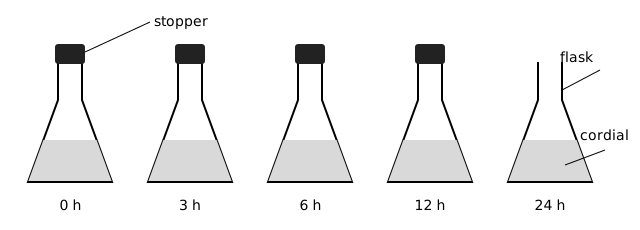
A student investigates how exposure to the air affects the hydrogensulfite concentration of one brand of blackcurrant cordial. The student fills identical flasks with equal volumes of the cordial, seals them and stores them in a refrigerator for 12 days. Once a day each flask is opened for a fixed period, which differs from flask to flask, as shown.
 Powiększ
Polecenie
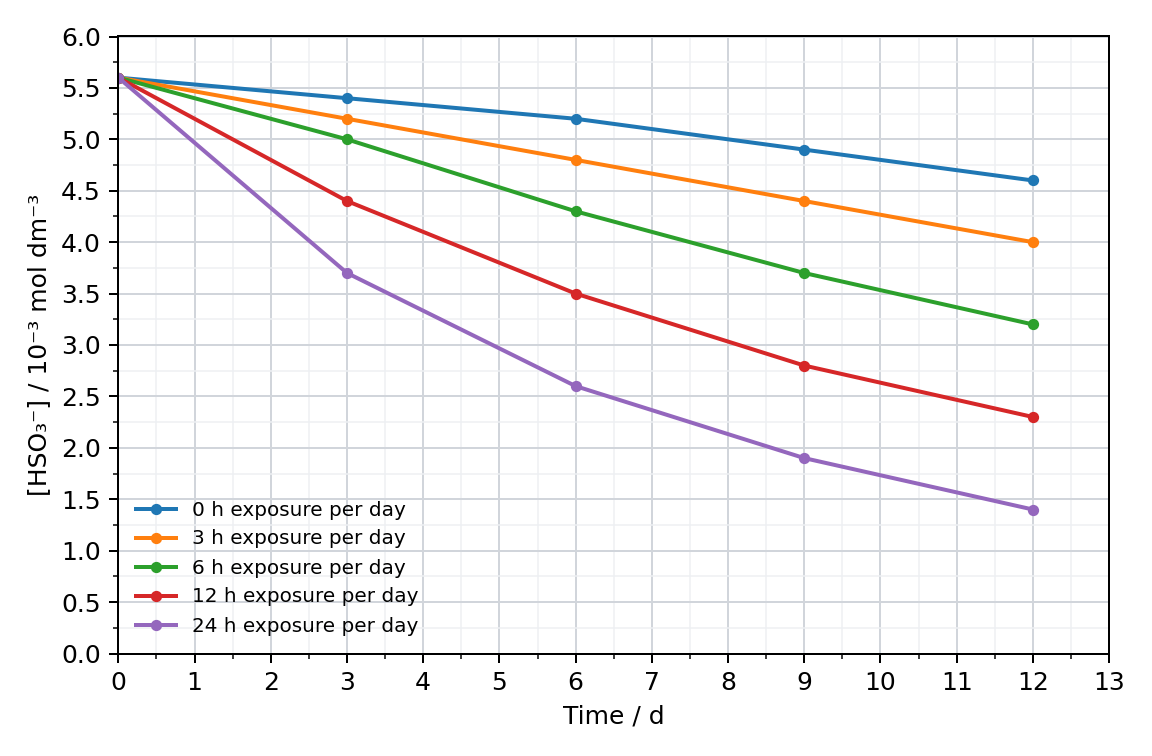
The student's results are plotted below.
 Powiększ
(i) Calculate the average rate at which the hydrogensulfite concentration in the 24 h flask decreased over the 12 days. Include units in your answer.
(ii) Before starting, the student wrote this hypothesis: "The longer the cordial is exposed to the air each day, the lower its hydrogensulfite concentration will be, because hydrogensulfite ions are oxidized by oxygen." Discuss whether the results support this hypothesis.
(iii) State what the results imply about how an opened bottle of cordial should be stored to preserve its sulfite content.
Korepetytor AI
Nie wiesz, jak ruszyć? Korepetytor zna to zadanie i poprowadzi Cię krok po kroku, bez gotowca.
3 rozmowy · bez karty · Zaloguj się
Sprawdź się
Odpowiedz i oceń, jak poszło. Klucz odsłoń dopiero, gdy masz swoją odpowiedź.
Zanim porównasz z kluczem
Jak poszło Ci z tym zadaniem?
Zaloguj się, żeby zapisać ocenę i wrócić do zadania później.
Pokaż rozwiązanieUkryj rozwiązanieKlucz i punktacja
Odpowiedź z klucza
(i) « =» 3.5 × 10⁻⁴ ✔
mol dm−3 d−1 ✔
(ii) «supports» the longer the daily exposure to air, the lower the concentration at every sampling time
OR
the 0 h flask shows the smallest decrease ✔
«does not fully support» there is no direct evidence that oxygen is responsible for the loss «sulfur dioxide could escape from the open flask as a gas / some other reaction could consume the hydrogensulfite» ✔
(iii) keep the bottle tightly closed «with as little air above the cordial as possible»
OR
use the cordial within a few days/weeks of opening ✔
Schemat punktowania
(i) M1: value in the range 3.4-3.6 × 10⁻⁴; M2: unit mol dm−3 d−1 (accept equivalent units with a correctly converted value: 3.9-4.2 × 10⁻⁹ mol dm−3 s−1 or 0.34-0.36 mmol dm−3 d−1). (ii) [1] for a point in favour of the hypothesis taken from the data, [1] for recognizing that the data do not show that oxygen is the cause; both are needed for [2]. (iii) [1] for a storage recommendation that follows from the results. Do not accept vague statements such as 'store it carefully'.
Komentarz. The second mark in (ii) is the one students miss: a correlation between exposure and loss does not prove that oxygen is the cause, and sulfur dioxide is volatile enough to leave the open flask without reacting.