Zadanie 3c
Wzorowane na: Chemistry SL Paper 2, November 2022, pytanie 3(c). Treść, dane i kontekst są zmienione; sprawdzane umiejętności, format i punktacja jak w oryginale.
Darmowe konto pozwoli wrócić do niego później.
Informacja do zadań 3a-3c.
Consider the following reaction:
Ni(s) + 2 Ag+(aq) → Ni2+(aq) + 2 Ag(s)
Polecenie
The diagram shows an unlabelled voltaic cell for the reaction:
Ni(s) + 2 Ag+(aq) → Ni2+(aq) + 2 Ag(s)
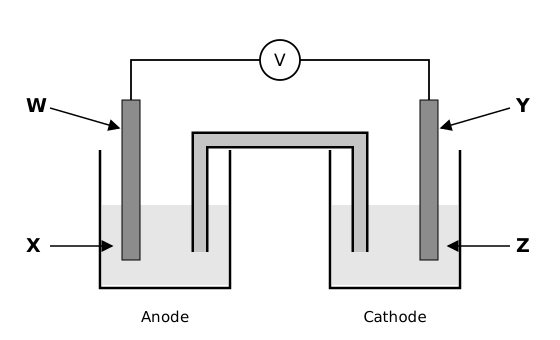
(i) Identify, using species from the equation, what W, X, Y and Z are, and state the direction of electron flow in the external circuit.
(ii) Write the half-equation for the reaction occurring at the anode (negative electrode).
(iii) The two half-cells are connected by a salt bridge filled with a saturated solution of potassium nitrate. Outline the function of the salt bridge.
(iv) Predict the movement of all ionic species through the salt bridge.
Sprawdź rozwiązanieUkryj rozwiązanieKlucz i punktacja
Odpowiedź z klucza
(i) W: Ni «electrode», X: Ni2+ «aq», Y: Ag «electrode», Z: Ag+ «aq» ✔
electrons flow from the anode to the cathode in the external circuit «left to right» ✔
(ii) Ni(s) → Ni2+(aq) + 2 e− ✔
(iii) «keeps» each half-cell / electrolyte «electrically» neutral
OR
completes the circuit by allowing ions to move between the half-cells ✔
(iv) NO3− moves towards the anode / Ni half-cell / left ✔
K+ moves towards the cathode / Ag half-cell / right ✔
Schemat punktowania
(i) M1: all four species correct (accept any soluble silver salt for Ag+ and any soluble nickel(II) salt for Ni2+); M2: direction of electron flow. Do not apply ECF for M2. (ii) 1 mark; accept the equilibrium arrow; do not award for the reverse reaction. (iii) 1 mark. (iv) M1 and M2 as in the key; award [1 max] for 'anions to the anode and cations to the cathode' without naming the ions.
Komentarz
A salt bridge with potassium chloride would be unsuitable here because chloride ions would precipitate silver ions.