Zadanie 2a, Paper 2, specimen 2025, Chemia IB SL
Wzorowane na: Chemistry SL Paper 2, specimen 2025, pytanie 2(a). Treść, dane i kontekst są zmienione; sprawdzane umiejętności, format i punktacja jak w oryginale.
Darmowe konto pozwoli wrócić do niego później.
Zadanie
Wspólne informacje do wiązki zadań
Scientific models of the structure of the atom have been developed and revised as new experimental evidence became available.
Polecenie
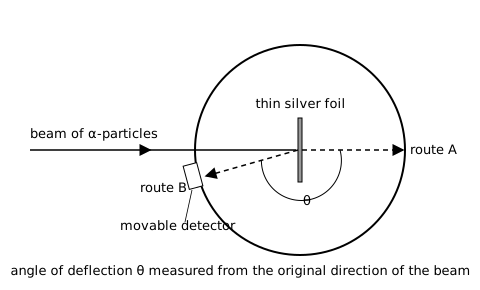
In the Geiger–Marsden experiment, α-particles (the nuclei of helium-4 atoms) were fired at a very thin foil of silver. A detector that could be moved around the foil recorded the angle of deflection, θ, of the particles. Two of the possible routes are shown: route A, straight through the foil, and route B, back towards the source.
 Powiększ
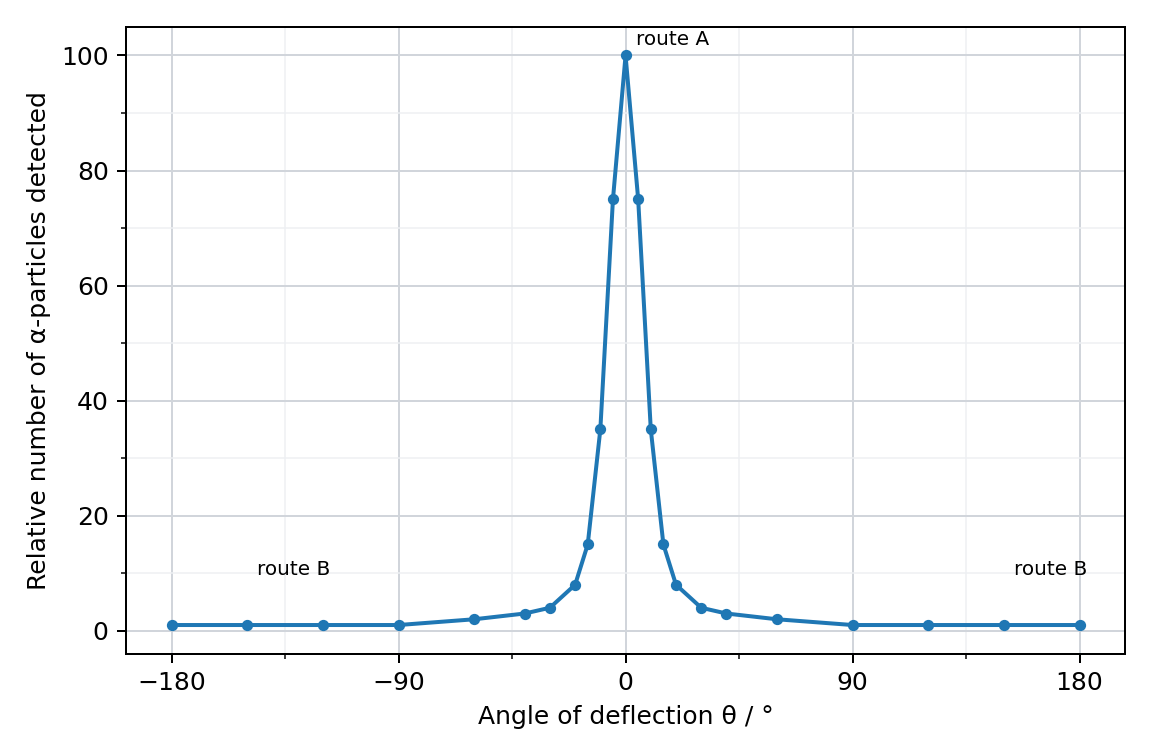
The graph shows how the relative number of α-particles reaching the detector varies with the angle of deflection.
 Powiększ
(i) State the nuclear charges of silver and helium.
(ii) Explain why a very small number of α-particles follow route B and are deflected back towards the source.
(iii) The great majority of the α-particles follow route A and pass through the foil without being deflected (θ = 0°). Suggest what this observation indicates about the structure of the atom.
Korepetytor AI
Nie wiesz, jak ruszyć? Korepetytor zna to zadanie i poprowadzi Cię krok po kroku, bez gotowca.
3 rozmowy · bez karty · Zaloguj się
Sprawdź się
Odpowiedz i oceń, jak poszło. Klucz odsłoń dopiero, gdy masz swoją odpowiedź.
Zanim porównasz z kluczem
Jak poszło Ci z tym zadaniem?
Zaloguj się, żeby zapisać ocenę i wrócić do zadania później.
Pokaż rozwiązanieUkryj rozwiązanieKlucz i punktacja
Odpowiedź z klucza
(i) silver: +47 AND helium: +2 ✔
(ii) «the positively charged α-particle is» repelled by the positively charged «silver» nucleus «when it passes very close to it» ✔
(iii) most of the volume of the atom is empty space
OR
the nucleus is very small «compared with the size of the atom» ✔
Schemat punktowania
One mark per sub-part. (i) both charges required, sign and magnitude; (ii) repulsion between like charges, the nucleus must be identified as positive; (iii) either the empty-space or the tiny-nucleus statement.