Zadanie 5b, Paper 2, specimen 2025, Chemia IB SL
Wzorowane na: Chemistry SL Paper 2, specimen 2025, pytanie 5(b). Treść, dane i kontekst są zmienione; sprawdzane umiejętności, format i punktacja jak w oryginale.
Darmowe konto pozwoli wrócić do niego później.
Zadanie
Wspólne informacje do wiązki zadań
Halogens and their compounds are used as reactants in the laboratory and in industry.
Polecenie
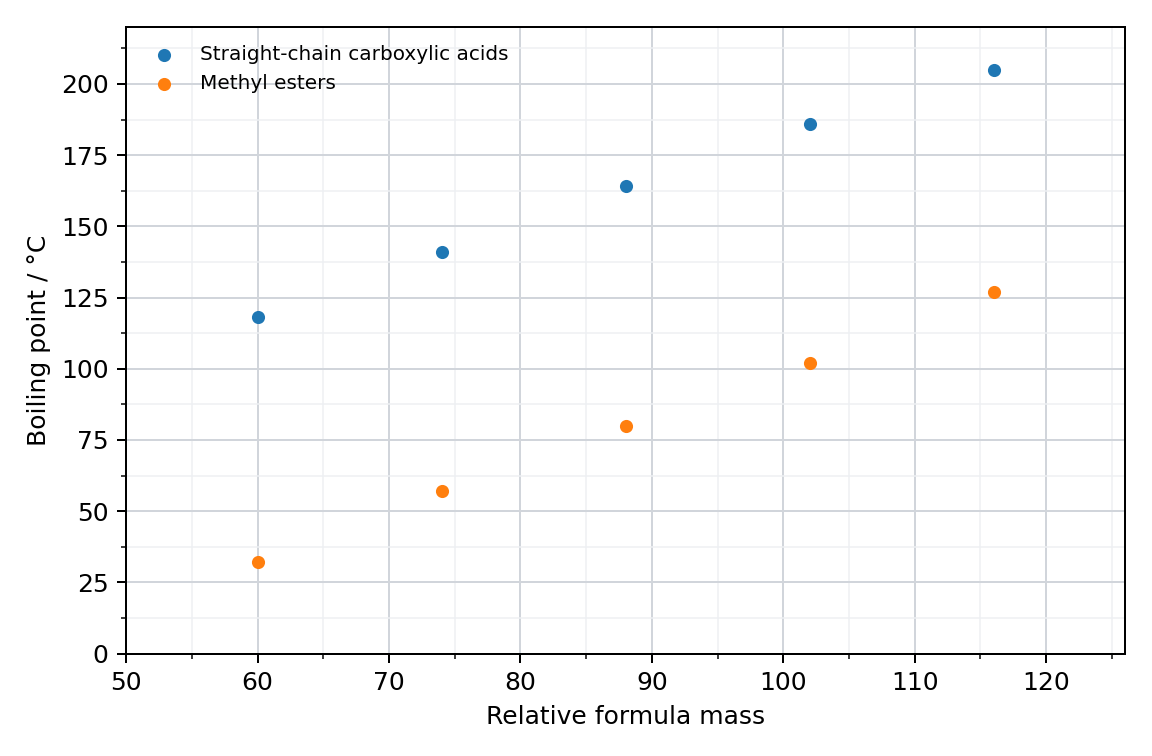
The graph shows the boiling points of five straight-chain carboxylic acids and of the five methyl esters that have the same relative formula masses as the acids.
 Powiększ
(i) Outline why the carboxylic acids have higher boiling points than the esters with the same relative formula mass.
(ii) Explain the general trend shown by the boiling points of the esters.
Korepetytor AI
Nie wiesz, jak ruszyć? Korepetytor zna to zadanie i poprowadzi Cię krok po kroku, bez gotowca.
3 rozmowy · bez karty · Zaloguj się
Sprawdź się
Odpowiedz i oceń, jak poszło. Klucz odsłoń dopiero, gdy masz swoją odpowiedź.
Zanim porównasz z kluczem
Jak poszło Ci z tym zadaniem?
Zaloguj się, żeby zapisać ocenę i wrócić do zadania później.
Pokaż rozwiązanieUkryj rozwiązanieKlucz i punktacja
Odpowiedź z klucza
(i) carboxylic acid molecules form hydrogen bonds with each other, which are stronger than the dipole–dipole forces between ester molecules ✔
(ii) «boiling point increases because» the London (dispersion) forces become stronger ✔
molecules have more electrons
OR
larger surface area / more contact between molecules ✔
Schemat punktowania
(i) [1] hydrogen bonding in the acids compared with dipole–dipole forces in the esters. (ii) [2]: M1 stronger London (dispersion) forces; M2 more electrons or greater surface contact. "Stronger intermolecular forces" alone does not score M1.
Komentarz. Esters cannot hydrogen bond with each other because they have no O–H bond; the trend within one series is a London-forces argument, not a polarity argument.