Zadanie 4d
Wzorowane na: Chemistry HL Paper 3, November 2023, TZ1, pytanie 4(d). Treść, dane i kontekst są zmienione; sprawdzane umiejętności, format i punktacja jak w oryginale.
Darmowe konto pozwoli wrócić do niego później.
Polecenie
Glycine, H2NCH2COOH, loses a proton from its carboxyl group in alkaline solution to form the glycinate ion. The glycinate ion can bond to a copper(II) ion through two of its atoms, so it acts as a bidentate ligand.
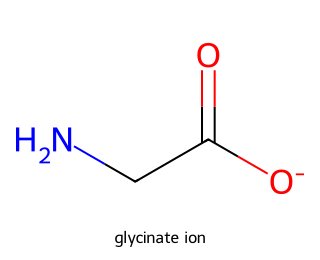
Explain how a glycinate ion bonds to a Cu2+ ion as a bidentate ligand.
Sprawdź rozwiązanieUkryj rozwiązanieKlucz i punktacja
Odpowiedź z klucza
non-bonding/lone pairs of electrons on the nitrogen atom AND on an oxygen atom «of the carboxylate group» ✔
each lone pair is donated to/shared with an empty/vacant orbital on the Cu2+ ion, forming a coordination bond ✔
two coordination bonds from one glycinate ion to the same Cu2+ ion, one from N and one from O ✔
Schemat punktowania
M1: lone pairs on the two donor atoms, N and O. M2: donation of the pairs into empty orbitals of the copper ion to form coordination (dative covalent) bonds. M3: two bonds from the one ion, which is what 'bidentate' means. Do not award M3 for three coordination bonds from one glycinate ion.