Zadanie 5a, Paper 2, listopad 2025, TZ1, Chemia IB HL
Wzorowane na: Chemistry HL Paper 2, November 2025, TZ1, pytanie 5(a). Treść, dane i kontekst są zmienione; sprawdzane umiejętności, format i punktacja jak w oryginale.
Darmowe konto pozwoli wrócić do niego później.
Zadanie
Wspólne informacje do wiązki zadań
Compounds of transition elements are widely used as electrode materials in secondary (rechargeable) cells, because these elements can exist in more than one oxidation state. Transition elements are also deposited as thin protective or decorative layers by electroplating.
Polecenie
(i) In the nickel–metal hydride (NiMH) rechargeable battery the negative electrode is a metal alloy, M, that absorbs hydrogen. The two electrode reactions during discharge are shown below.
MH(s) + OH−(aq) ⇌ M(s) + H2O(l) + e−
NiO(OH)(s) + H2O(l) + e− ⇌ Ni(OH)2(s) + OH−(aq)
Deduce the overall cell equation.
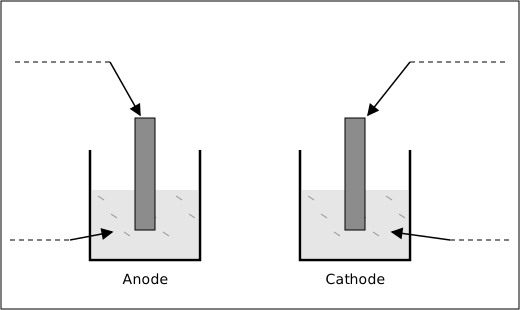
(ii) Simple voltaic cells make use of the difference in standard electrode potential between two half-cells. Shown below is an incomplete set-up for measuring the cell potential between Fe2+(aq)/Fe and Cu2+(aq)/Cu half-cells.
 Powiększ
Draw in the missing components, and add full labels, so that the diagram shows how this cell potential could actually be measured.
(iii) For this cell, calculate the standard cell potential, Ecell⊖. Use section 19 of the data booklet.
Korepetytor AI
Nie wiesz, jak ruszyć? Korepetytor zna to zadanie i poprowadzi Cię krok po kroku, bez gotowca.
3 rozmowy · bez karty · Zaloguj się
Sprawdź się
Odpowiedz i oceń, jak poszło. Klucz odsłoń dopiero, gdy masz swoją odpowiedź.
Zanim porównasz z kluczem
Jak poszło Ci z tym zadaniem?
Zaloguj się, żeby zapisać ocenę i wrócić do zadania później.
Pokaż rozwiązanieUkryj rozwiązanieKlucz i punktacja
Odpowiedź z klucza
(i) MH(s) + NiO(OH)(s) → M(s) + Ni(OH)2(s) ✔
(ii) salt bridge connecting the two solutions ✔
voltmeter connected to the two electrodes by wires ✔
electrodes labelled Fe «anode» AND Cu «cathode» AND solutions labelled Fe2+(aq) AND Cu2+(aq) ✔
(iii) Ecell⊖ = «+0.34 − (−0.45) =» +0.79 «V» ✔
Schemat punktowania
(i) [1] for the overall equation with water and hydroxide ions cancelled; accept an equilibrium arrow. (ii) M1: salt bridge in contact with both solutions; M2: voltmeter and wires connecting both electrodes; M3: electrodes and ions in solution correctly labelled. Ignore the direction of electron flow and standard conditions. (iii) [1] for +0.79 V.
Komentarz. Iron has the more negative electrode potential, so it is oxidized at the anode; the cell potential is the difference between the two standard electrode potentials, not their sum.