Zadanie 7c, Paper 2, maj 2025, TZ3, Chemia IB HL
Wzorowane na: Chemistry HL Paper 2, May 2025, TZ3, pytanie 7(c). Treść, dane i kontekst są zmienione; sprawdzane umiejętności, format i punktacja jak w oryginale.
Darmowe konto pozwoli wrócić do niego później.
Zadanie
Wspólne informacje do wiązki zadań
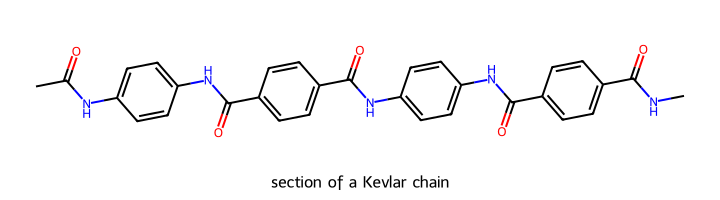
Kevlar is an aromatic polyamide used in protective clothing and in the reinforcement of tyres. A short section of the polymer chain is shown below; the methyl groups drawn at the two ends stand for the continuation of the chain.
 Powiększ
Polecenie
Discuss the melting points in the table below in terms of the bonding and/or intermolecular forces present in each substance.
| Substance | Melting point / K |
|---|---|
| Silicon dioxide (quartz) | 1986 |
| Poly(propene) | 433 |
Korepetytor AI
Nie wiesz, jak ruszyć? Korepetytor zna to zadanie i poprowadzi Cię krok po kroku, bez gotowca.
3 rozmowy · bez karty · Zaloguj się
Sprawdź się
Odpowiedz i oceń, jak poszło. Klucz odsłoń dopiero, gdy masz swoją odpowiedź.
Zanim porównasz z kluczem
Jak poszło Ci z tym zadaniem?
Zaloguj się, żeby zapisać ocenę i wrócić do zadania później.
Pokaż rozwiązanieUkryj rozwiązanieKlucz i punktacja
Odpowiedź z klucza
silicon dioxide is a covalent network «solid» with covalent bonds between Si and O atoms «throughout the structure, which must be broken on melting» ✔
«only» London / dispersion forces «need to be overcome» between poly(propene) chains / molecules ✔
covalent bonds are much stronger than London / dispersion / intermolecular forces «so silicon dioxide has the far higher melting point» ✔
Schemat punktowania
M1: covalent bonds in the SiO2 network; M2: London (dispersion) forces between poly(propene) chains; M3: covalent bonds much stronger than the intermolecular forces. For M3 do not accept 'the bonding in silicon dioxide is stronger' without naming the bonds or forces.
Komentarz. Melting poly(propene) leaves its C-C and C-H bonds intact; only the forces between the chains are overcome.