Zadanie 5b
Wzorowane na: Chemistry SL Paper 2, May 2024, TZ2, pytanie 5(b). Treść, dane i kontekst są zmienione; sprawdzane umiejętności, format i punktacja jak w oryginale.
Darmowe konto pozwoli wrócić do niego później.
Informacja do zadań 5a-5b.
A student studied the kinetics of the reaction between a purple dye, D+, and aqueous sodium hydroxide, represented by the equation below.
D+(aq) + OH−(aq) → DOH(aq)
The ion D+ is intensely purple and DOH is colourless.
In a preliminary experiment the student timed how long the purple colour of the mixture described in the table took to vanish, and estimated the rate of reaction from the expression below.
estimated rate = [D+]/ time for colour to disappear
| Initial [D+] / mol dm−3 | Initial [OH−] / mol dm−3 | Time for colour to disappear / s | Estimated rate / mol dm−3 s−1 |
|---|---|---|---|
| 2.50 × 10⁻⁶ | 4.00 × 10⁻² | 140 | 1.79 × 10⁻⁸ |
Polecenie
The student then followed the reaction with a spectrophotometer, which records the light absorbed by the mixture and so gives the concentration of the dye throughout the reaction.
| Experiment | Initial [D+] / mol dm−3 | Initial [OH−] / mol dm−3 | Initial rate / mol dm−3 s−1 |
|---|---|---|---|
| 1 | 2.50 × 10⁻⁶ | 4.00 × 10⁻² | 2.20 × 10⁻⁸ |
| 2 | 1.25 × 10⁻⁶ | 1.00 × 10⁻² | 2.75 × 10⁻⁹ |
| 3 | missing | 4.00 × 10⁻² | missing |
The graph shows [D+] against time for experiment 3.
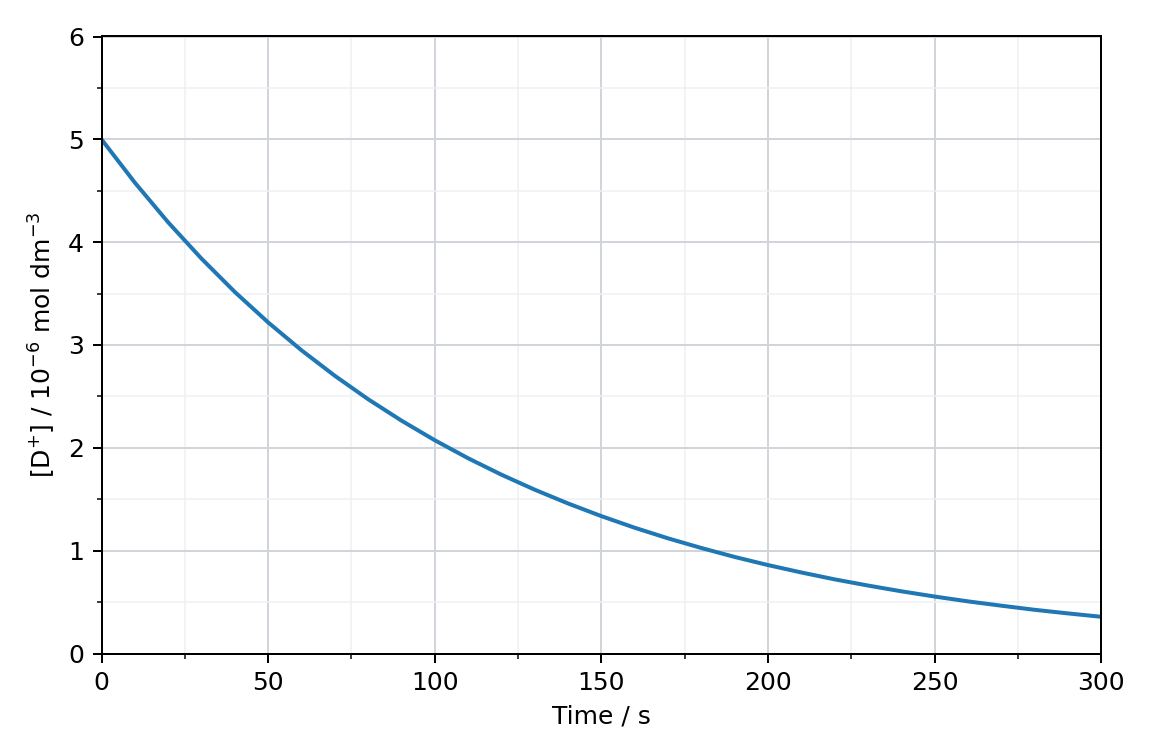
(i) Use the graph to determine the two missing entries for experiment 3 in the table, and justify your values.
(ii) Outline, on a molecular level, why the rate of the reaction decreases with time.
Sprawdź rozwiązanieUkryj rozwiązanieKlucz i punktacja
Odpowiedź z klucza
(i) initial [D+] = 5.00 × 10⁻⁶ mol dm−3 «the intercept of the curve with the vertical axis at 0 s» ✔
initial rate «= −gradient of the tangent at 0 s»: tangent drawn at 0 s AND evidence of a gradient calculation «e.g. the tangent meets the time axis at about 114 s, so the gradient is 5.00 × 10⁻⁶/114» ✔
initial rate = 4.4 × 10⁻⁸ mol dm−3 s−1 «accept 4.0 to 4.8 × 10⁻⁸» ✔
(ii) the frequency of collisions between D+ and OH− ions decreases with time «as their concentrations fall» ✔
Schemat punktowania
(i) M1: initial concentration; M2: tangent at t = 0 with a gradient calculation; M3: initial rate in the accepted range. (ii) [1]: the frequency or probability of collisions decreases as the reactants are consumed. Do not accept "fewer collisions" without reference to time.