Zadanie 1b
Wzorowane na: Chemistry SL Paper 3, May 2024, TZ2, pytanie 1(b). Treść, dane i kontekst są zmienione; sprawdzane umiejętności, format i punktacja jak w oryginale.
Darmowe konto pozwoli wrócić do niego później.
Informacja do zadań 1a-1b.
The decomposition of aqueous hydrogen peroxide is catalysed by iodide ions:
2 H2O2(aq) → 2 H2O(l) + O2(g)
Polecenie
The concentration of hydrogen peroxide in a reaction mixture was followed for 600 s and the results are plotted in the graph.
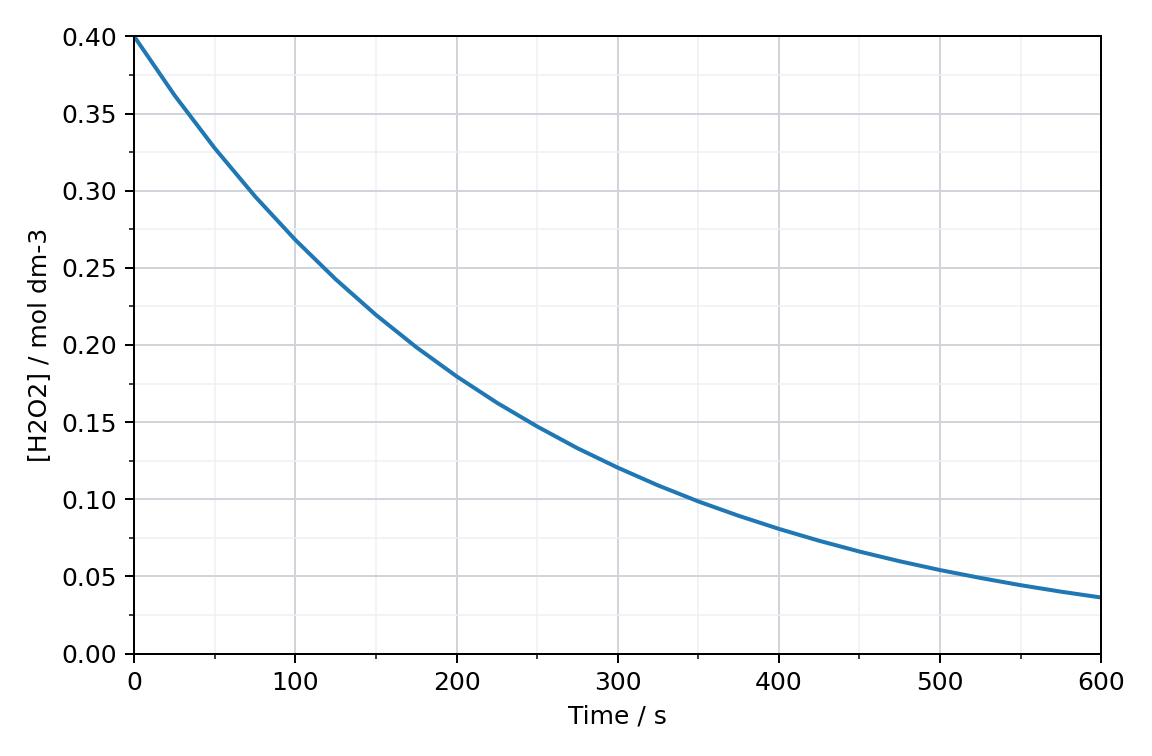
(i) Determine the instantaneous rate of the reaction, to two significant figures, when [H2O2] = 0.160 mol dm−3.
(ii) Outline why the gradient of the graph is negative and also not constant.
Sprawdź rozwiązanieUkryj rozwiązanieKlucz i punktacja
Odpowiedź z klucza
(i) tangent drawn to the curve at [H2O2] = 0.160 mol dm−3 «at about 230 s» ✔
«rate = −gradient of tangent, for example » 6.4 × 10⁻⁴ «mol dm−3 s−1» ✔
final answer given to two significant figures ✔
(ii) negative gradient: hydrogen peroxide is used up, so its concentration falls as the reaction proceeds ✔
gradient not constant: the rate depends on the concentration, so the rate falls as the concentration falls «fewer collisions between reacting particles per unit time» ✔
Schemat punktowania
(i) M1: tangent at the stated concentration. M2: rate from the gradient; accept 5.8 × 10⁻⁴ to 7.0 × 10⁻⁴ mol dm−3 s−1 and ignore the sign. M3: any numerical result with two significant figures. Award [2 max] for a correct rate quoted to three significant figures, for example 6.43 × 10⁻⁴. (ii) Two reasons, one mark each. For the second reason "the rate decreases" without a link to concentration or collisions earns nothing.