Zadanie 1c
Wzorowane na: Chemistry HL Paper 2, November 2022, pytanie 1(c). Treść, dane i kontekst są zmienione; sprawdzane umiejętności, format i punktacja jak w oryginale.
Darmowe konto pozwoli wrócić do niego później.
Informacja do zadań 1a-1f.
Ammonium chloride, NH4Cl, is a white crystalline solid used as a nitrogen fertilizer for rice crops and as an electrolyte in dry cells.
Polecenie
A 0.50 mol dm−3 solution of ammonium chloride is prepared.
(i) Calculate the pH of an ammonium chloride solution with [H3O+] = 1.68 × 10⁻⁵ mol dm−3. Use section 1 of the data booklet.
(ii) Write the equation for the neutralization of the ammonium chloride solution by sodium hydroxide solution.
(iii) A 25.00 cm3 sample of the 0.50 mol dm−3 solution of ammonium chloride is titrated with a 0.50 mol dm−3 solution of sodium hydroxide. The pKb of ammonia is 4.75. Determine the pH at the equivalence point, to two decimal places. Use section 1 of the data booklet.
(iv) Sketch the pH curve for the titration in (iii), up to a total of 50 cm3 of sodium hydroxide solution added, on the axes provided.
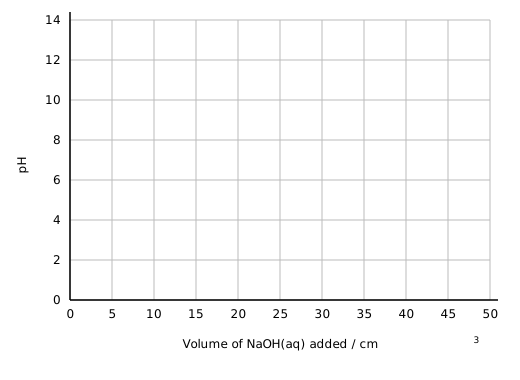
(v) State, with a reason, if phenol red is an appropriate indicator for this titration. Use section 18 of the data booklet.
Sprawdź rozwiązanieUkryj rozwiązanieKlucz i punktacja
Odpowiedź z klucza
(i) «pH = −log(1.68 × 10⁻⁵) =» 4.77 ✔
(ii) NH4+(aq) + OH−(aq) → NH3(aq) + H2O(l)
OR
NH4Cl(aq) + NaOH(aq) → NH3(aq) + H2O(l) + NaCl(aq) ✔
(iii) «n(NH4+) = 0.50 mol dm−3 × 0.02500 dm3 =» 0.0125 «mol» ✔
«at the equivalence point 25.00 cm3 of NaOH has been added, so the total volume is 50.00 cm3»
« =» 0.25 «mol dm−3» ✔
«Kb = 10−4.75 = 1.78 × 10⁻⁵»
« =» 2.1 × 10⁻³ «mol dm−3» ✔
«pOH = −log(2.1 × 10⁻³) = 2.68»
«pH = 14.00 − 2.68 =» 11.32 ✔
(iv) non-symmetrical S-shaped curve starting at a pH between 2 and 7 «about 4.8» AND levelling off at a pH above 12 ✔
equivalence point at a pH of approximately 11 AND at a volume of 25 cm3 ✔
(v) no AND the equivalence point «pH 11.3» does not lie within the pH range of the indicator «6.8–8.4»
OR
no AND there is no sharp rise in pH within the colour-change range of phenol red ✔
Schemat punktowania
(i) 1 mark. (ii) 1 mark; accept NH4OH instead of NH3 + H2O. (iii) Award [4] for the correct final answer (accept 11.31–11.33). M1: amount of ammonium ion; M2: concentration of ammonia at the equivalence point (total volume 50.00 cm3); M3: [OH−] from Kb; M4: pOH converted to pH. ECF from M1 and M2. (iv) M1: curve shape with start and end pH; M2: equivalence point at 25 cm3 and pH about 11 (accept 10–12). (v) 1 mark; the conclusion and the reason are both needed.
Komentarz
In (iii) the ammonium ion is the weak acid and ammonia the product: use Kb of ammonia for the conjugate base, not Ka of the ammonium ion.