Zadanie 3f
Wzorowane na: Chemistry HL Paper 2, November 2022, pytanie 3(f). Treść, dane i kontekst są zmienione; sprawdzane umiejętności, format i punktacja jak w oryginale.
Darmowe konto pozwoli wrócić do niego później.
Informacja do zadań 3a-3f.
Consider the following reaction:
Ni(s) + 2 Ag+(aq) → Ni2+(aq) + 2 Ag(s)
Polecenie
The diagram shows an unlabelled voltaic cell for the reaction:
Ni(s) + 2 Ag+(aq) → Ni2+(aq) + 2 Ag(s)
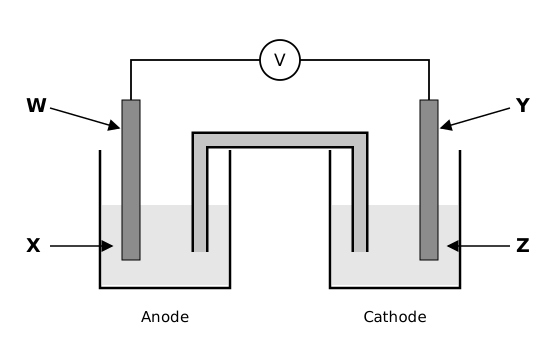
(i) Identify, using species from the equation, what W, X, Y and Z are, and state the direction of electron flow in the external circuit.
(ii) Write the half-equation for the reaction occurring at the anode (negative electrode).
(iii) The two half-cells are connected by a salt bridge filled with a saturated solution of potassium nitrate. Outline the function of the salt bridge.
(iv) Predict the movement of all ionic species through the salt bridge.
(v) Calculate the standard cell potential, in V, for this cell. Use section 19 of the data booklet.
(vi) Calculate the standard Gibbs energy change, in kJ, for the cell. Use your answer to (v) and sections 1 and 2 of the data booklet.
If you did not obtain an answer in (v), use 0.86 V, although this is not the correct answer.
Sprawdź rozwiązanieUkryj rozwiązanieKlucz i punktacja
Odpowiedź z klucza
(i) W: Ni «electrode», X: Ni2+ «aq», Y: Ag «electrode», Z: Ag+ «aq» ✔
electrons flow from the anode to the cathode in the external circuit «left to right» ✔
(ii) Ni(s) → Ni2+(aq) + 2 e− ✔
(iii) «keeps» each half-cell / electrolyte «electrically» neutral
OR
completes the circuit by allowing ions to move between the half-cells ✔
(iv) NO3− moves towards the anode / Ni half-cell / left ✔
K+ moves towards the cathode / Ag half-cell / right ✔
(v) «Ecell⊖ = +0.80 − (−0.26) =» +1.06 «V» ✔
(vi) «ΔG⊖ = −nFE⊖ = −2 mol × 9.65 × 104 C mol−1 × 1.06 V =» −205 «kJ» ✔
Schemat punktowania
(i) M1: all four species correct (accept any soluble silver salt for Ag+ and any soluble nickel(II) salt for Ni2+); M2: direction of electron flow. Do not apply ECF for M2. (ii) 1 mark; accept the equilibrium arrow; do not award for the reverse reaction. (iii) 1 mark. (iv) M1 and M2 as in the key; award [1 max] for 'anions to the anode and cations to the cathode' without naming the ions. (v) 1 mark. (vi) 1 mark for −204 to −205 kJ; if 0.86 V is used, the answer is −166 kJ.
Komentarz
A salt bridge with potassium chloride would be unsuitable here because chloride ions would precipitate silver ions.