Zadanie 4a
Wzorowane na: Chemistry HL Paper 2, November 2022, pytanie 4(a). Treść, dane i kontekst są zmienione; sprawdzane umiejętności, format i punktacja jak w oryginale.
Darmowe konto pozwoli wrócić do niego później.
Informacja do zadań 4a-4b.
An organic compound, A, reacts with propanoic acid to produce compound B, using concentrated sulfuric acid as a catalyst.
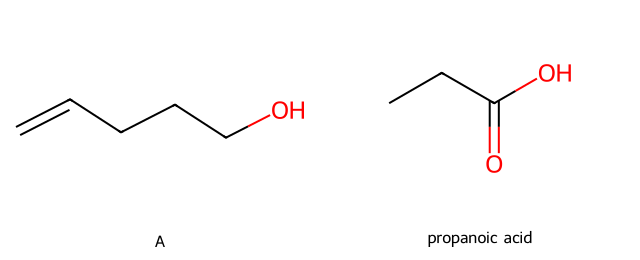
A + CH3CH2COOH ⇌ B + H2O
Polecenie
(i) Deduce the structural formula and the empirical formula of B.
(ii) Explain, with reference to Le Châtelier’s principle, the effect on the yield of B of using dilute rather than concentrated sulfuric acid as the catalyst.
(iii) Compound A has a lower molar mass than B but is less volatile. Explain, with reference to intermolecular forces, why B is more volatile than A.
Sprawdź rozwiązanieUkryj rozwiązanieKlucz i punktacja
Odpowiedź z klucza
(i) Structural formula: CH2=CHCH2CH2CH2OC(=O)CH2CH3
ester functional group / −C(=O)O− linkage ✔
rest of the structure: pent-4-enyl group on the oxygen AND ethyl group on the carbonyl carbon ✔
«accept condensed, full structural or skeletal formula»
Empirical formula: C4H7O ✔
«C8H14O2 is the molecular formula of B, divided by 2»
(ii) dilute acid adds «extra» water
OR
water is a product ✔
equilibrium shifts to the left / towards the reactants AND the yield decreases ✔
(iii) A has hydrogen bonding «as well as dipole–dipole and London / dispersion forces» AND B has dipole–dipole «and London / dispersion forces» only
OR
A has hydrogen bonding AND B does not ✔
the intermolecular forces in B are weaker «than hydrogen bonds in A»
OR
hydrogen bonds are stronger than dipole–dipole forces ✔
Schemat punktowania
(i) M1: ester functional group; M2: rest of the structure correct for the alcohol and the acid used; M3: empirical formula. (ii) M1: water added or present as a product; M2: shift towards the reactants and lower yield. (iii) M1: types of force in A and B; M2: comparison of strength.