Zadanie 2a, Paper 2, specimen 2025, Chemia IB HL
Wzorowane na: Chemistry HL Paper 2, specimen 2025, pytanie 2(a). Treść, dane i kontekst są zmienione; sprawdzane umiejętności, format i punktacja jak w oryginale.
Darmowe konto pozwoli wrócić do niego później.
Zadanie
Wspólne informacje do wiązki zadań
The structure of the atom is described by models that have been tested against experimental evidence.
Polecenie
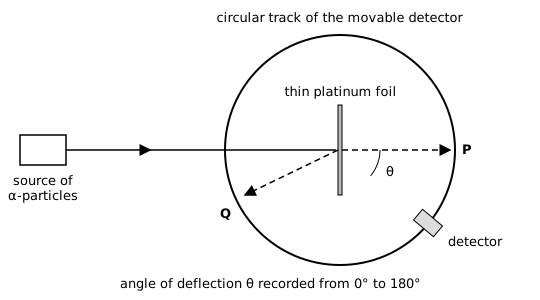
α-particles are the nuclei of helium-4 atoms. In an experiment based on the work of Geiger and Marsden, a beam of α-particles is directed at a very thin platinum foil and the angle of deflection, θ, of each particle is recorded by a detector that can be moved around the foil. Two possible trajectories are shown: trajectory P passes straight through the foil and trajectory Q returns towards the source.
 Powiększ
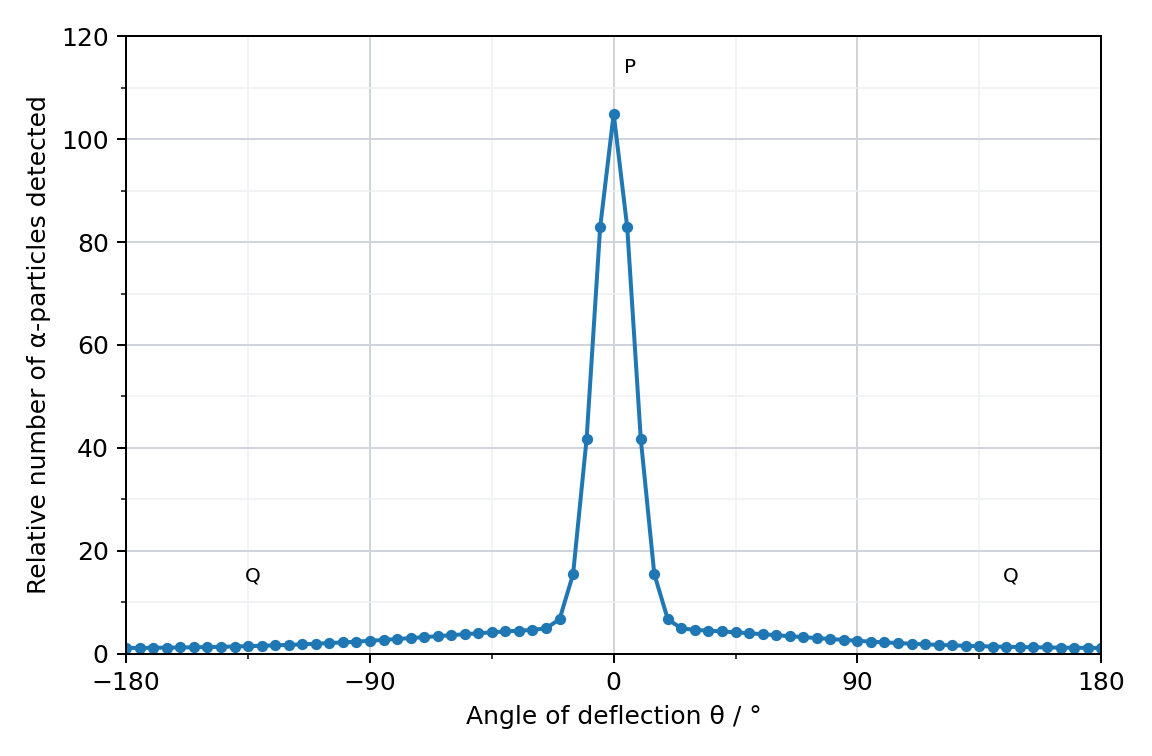
The relative number of α-particles detected at each angle of deflection is shown in the graph.
 Powiększ
(i) Explain why a small number of α-particles follow trajectory Q and are deflected back towards the source.
(ii) Almost all of the α-particles follow trajectory P and pass through the foil undeflected (θ = 0°). Suggest what this observation indicates about the structure of the atom.
Korepetytor AI
Nie wiesz, jak ruszyć? Korepetytor zna to zadanie i poprowadzi Cię krok po kroku, bez gotowca.
3 rozmowy · bez karty · Zaloguj się
Sprawdź się
Odpowiedz i oceń, jak poszło. Klucz odsłoń dopiero, gdy masz swoją odpowiedź.
Zanim porównasz z kluczem
Jak poszło Ci z tym zadaniem?
Zaloguj się, żeby zapisać ocenę i wrócić do zadania później.
Pokaż rozwiązanieUkryj rozwiązanieKlucz i punktacja
Odpowiedź z klucza
(i) «the α-particles pass very close to» a platinum nucleus, which is positively charged «and very dense», and are repelled by it ✔
(ii) the atom is mostly empty space
OR
the nucleus is very small compared with the size of the atom ✔
Schemat punktowania
(i) [1]: repulsion by the positive (dense) nucleus; a reference to collisions with electrons scores zero. (ii) [1]: empty space or tiny nucleus.
Komentarz. The evidence for a positive nucleus is the repulsion of the positively charged α-particles; the evidence for its small size is how rarely that happens.