Zadanie 3c, Paper 2, specimen 2025, Chemia IB HL
Wzorowane na: Chemistry HL Paper 2, specimen 2025, pytanie 3(c). Treść, dane i kontekst są zmienione; sprawdzane umiejętności, format i punktacja jak w oryginale.
Darmowe konto pozwoli wrócić do niego później.
Zadanie
Wspólne informacje do wiązki zadań
Sodium-ion batteries are being developed as a lower-cost alternative to lithium-ion batteries, because sodium is far more abundant than lithium.
Polecenie
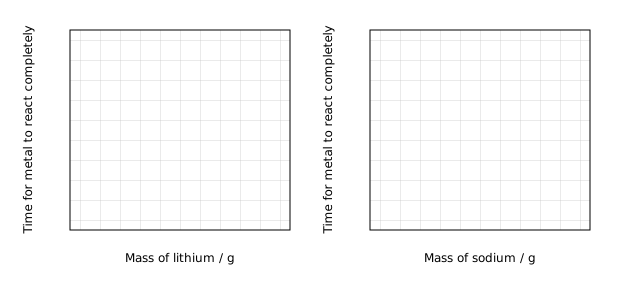
A computer simulation models what happens when small pieces of lithium and of sodium are dropped into water. For each metal five pieces of increasing mass are used, the same set of masses for both metals, and the simulation records how long each piece takes to react completely.
(i) Sketch, on the axes, the graphs showing the results you would expect for each metal.
 Powiększ
(ii) Suggest why the time taken by equal masses of the two metals to react completely does not give a valid comparison of their reactivity.
(iii) Sodium cyanide, NaCN, is one of many compounds of sodium that contain carbon. Using sections 9 and 17 of the data booklet, determine the percentage covalent character of the bonding between sodium and carbon in NaCN and classify the bonding type.
(iv) Use the data below and section 1 of the data booklet to calculate the standard Gibbs energy of formation, ΔGf⊖, of NaCN(s) at 298.15 K, in kJ mol−1.
ΔHf⊖ NaCN(s) = −87 kJ mol−1
ΔSf⊖ NaCN(s) = −37 J K−1 mol−1
(v) Draw the Lewis formula of the cyanide ion, the anion present in NaCN.
(vi) State the hybridization of the carbon atom in the cyanide ion.
Korepetytor AI
Nie wiesz, jak ruszyć? Korepetytor zna to zadanie i poprowadzi Cię krok po kroku, bez gotowca.
3 rozmowy · bez karty · Zaloguj się
Sprawdź się
Odpowiedz i oceń, jak poszło. Klucz odsłoń dopiero, gdy masz swoją odpowiedź.
Zanim porównasz z kluczem
Jak poszło Ci z tym zadaniem?
Zaloguj się, żeby zapisać ocenę i wrócić do zadania później.
Pokaż rozwiązanieUkryj rozwiązanieKlucz i punktacja
Odpowiedź z klucza
(i) two increasing lines/curves, one on each grid ✔
line for lithium steeper / higher than the line for sodium «lithium takes longer for every mass» ✔
(ii) the same mass of each metal corresponds to a different amount / number of moles of metal «1 g of Li is 0.144 mol but 1 g of Na is 0.0435 mol» ✔
(iii) «χ(Na) = 0.9 and χ(C) = 2.6
electronegativity difference = 1.7
average electronegativity = 1.75»
percentage covalent character = «about» 45 % «accept 40–50 %» ✔
ionic ✔
(iv) «ΔG⊖ = ΔH⊖ − TΔS⊖ = −87 − 298.15 × (−0.037) = −87 + 11.0 =» −76 «kJ mol−1» ✔
(v) [ :C≡N: ]⁻ «triple bond between C and N with one lone pair on each atom, 10 valence electrons in total» ✔
negative (1−) charge shown on the ion ✔
(vi) sp ✔
Schemat punktowania
(i) [2]: M1 two increasing lines or curves; M2 lithium steeper or higher than sodium. (ii) [1]. (iii) [2]: M1 percentage covalent character read from the triangle for an electronegativity difference of 1.7 (accept 40–50 %); M2 ionic. (iv) [1]: −76 kJ mol⁻¹ (accept −75.9 to −76.0); the entropy change must be converted to kJ. (v) [2]: M1 triple bond with one lone pair on each atom; M2 the 1− charge. (vi) [1]: sp.
Komentarz. Lithium is less reactive than sodium and one gram of it contains about three times as many atoms, so both effects lengthen its reaction time; in (iv) the entropy term contributes only +11 kJ mol⁻¹.