Zadanie 2b, Paper 2, specimen 2025, Chemia IB HL
Wzorowane na: Chemistry HL Paper 2, specimen 2025, pytanie 2(b). Treść, dane i kontekst są zmienione; sprawdzane umiejętności, format i punktacja jak w oryginale.
Darmowe konto pozwoli wrócić do niego później.
Zadanie
Wspólne informacje do wiązki zadań
The structure of the atom is described by models that have been tested against experimental evidence.
Polecenie
The presence of hydrogen in stars is deduced from lines in their spectra.
(i) Outline what the emission spectrum of hydrogen looks like.
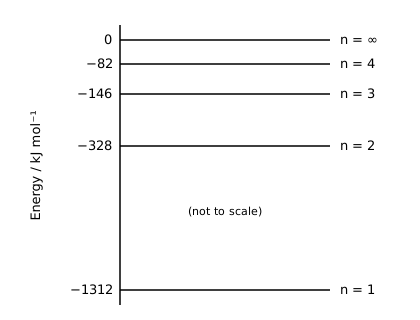
Emission spectra of species that contain a single electron can be explained by a model in which the electron is held by the electrostatic attraction of the nucleus and can occupy only certain energy levels. Some of the energy levels of the hydrogen atom are shown.
 Powiększ
(ii) Explain how the frequencies of the emitted light provide evidence that the electron can only occupy certain energy levels.
(iii) Use the energy levels shown to deduce the ionization energy of the hydrogen atom.
(iv) The ionization energy of the He+ ion is about four times larger than that of the hydrogen atom. Suggest two reasons for this difference.
(v) Suggest why this model gives the correct emission spectrum for the hydrogen atom but fails for the helium atom.
Korepetytor AI
Nie wiesz, jak ruszyć? Korepetytor zna to zadanie i poprowadzi Cię krok po kroku, bez gotowca.
3 rozmowy · bez karty · Zaloguj się
Sprawdź się
Odpowiedz i oceń, jak poszło. Klucz odsłoń dopiero, gdy masz swoją odpowiedź.
Zanim porównasz z kluczem
Jak poszło Ci z tym zadaniem?
Zaloguj się, żeby zapisać ocenę i wrócić do zadania później.
Pokaż rozwiązanieUkryj rozwiązanieKlucz i punktacja
Odpowiedź z klucza
(i) a series of separate/discrete lines «of specific frequencies, which become closer together at higher frequency» ✔
(ii) each line corresponds to photons of one specific frequency/energy «E = hf» ✔
the energy of the photon equals the difference between two energy levels, so only certain frequencies can be emitted ✔
(iii) «0 − (−1312) =» 1312 «kJ mol−1» ✔
(iv) He+ has a larger nuclear charge / two protons «compared with one in H» ✔
the electron in He+ is closer to the nucleus / He+ has a smaller radius «about half that of H» ✔
(v) the helium atom has two electrons, so repulsion between electrons «must be taken into account, while the model considers only the nucleus–electron attraction» ✔
Schemat punktowania
(i) [1]. (ii) [2]: M1 each line corresponds to a photon of one frequency (or energy); M2 photon energy equals a difference between two levels, so only certain frequencies occur. (iii) [1]: 1312 kJ mol⁻¹ (accept 1310). (iv) [2]: one mark for nuclear charge, one for radius or distance of the electron from the nucleus. (v) [1]: electron–electron repulsion or more than one electron.
Komentarz. The ionization energy is the energy needed to take the electron from n = 1 to n = ∞, so it equals the magnitude of the lowest level, not the gap between n = 1 and n = 2.