Zadanie 5c, Paper 2, listopad 2025, TZ3, Chemia IB SL
Wzorowane na: Chemistry SL Paper 2, November 2025, TZ3, pytanie 5(c). Treść, dane i kontekst są zmienione; sprawdzane umiejętności, format i punktacja jak w oryginale.
Darmowe konto pozwoli wrócić do niego później.
Zadanie
Wspólne informacje do wiązki zadań
The relative abundances of the two isotopes in a sample of chlorine are shown below.
| Isotope | Relative abundance / % |
|---|---|
| 75.50 | |
| 24.50 |
Polecenie
(i) Deduce the condensed electron configuration of chlorine.
(ii) Describe the bonding in a molecule of chlorine in terms of valence electrons.
(iii) Explain why chlorine has a much lower boiling point than bromine, although both exist as simple diatomic molecules.
(iv) Deduce the equation, and the colour change observed, for the reaction of aqueous chlorine with a dilute aqueous bromide solution.
(v) Outline why chlorine does not react with an aqueous fluoride solution.
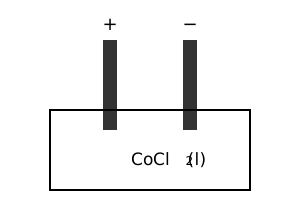
(vi) Deduce the products of the electrolysis of molten cobalt(II) chloride, CoCl2(l).
 Powiększ
Korepetytor AI
Nie wiesz, jak ruszyć? Korepetytor zna to zadanie i poprowadzi Cię krok po kroku, bez gotowca.
3 rozmowy · bez karty · Zaloguj się
Sprawdź się
Odpowiedz i oceń, jak poszło. Klucz odsłoń dopiero, gdy masz swoją odpowiedź.
Zanim porównasz z kluczem
Jak poszło Ci z tym zadaniem?
Zaloguj się, żeby zapisać ocenę i wrócić do zadania później.
Pokaż rozwiązanieUkryj rozwiązanieKlucz i punktacja
Odpowiedź z klucza
(i) [Ne]3s23p5 ✔
(ii) «single» shared pair «of electrons» between the two Cl atoms ✔
(iii) both Cl2 and Br2 are non-polar molecules with «only» London/dispersion forces between molecules ✔
Br2 has more electrons «greater molar mass» than Cl2, so stronger dispersion forces «between Br2 molecules, hence its higher boiling point» ✔
(iv) Cl2(aq) + 2 Br−(aq) → 2 Cl−(aq) + Br2(aq) ✔
colour change: «almost» colourless to orange/yellow ✔
(v) chlorine is a weaker oxidizing agent than fluorine / more difficult to reduce than fluorine ✔
(vi) Product at anode: chlorine / Cl2(g)
Product at cathode: cobalt / Co(s) ✔
Schemat punktowania
(i) [1]; do not accept the full, non-condensed electron configuration. (ii) [1]; do not accept just 'covalent'. (iii) M1: both molecules are non-polar with only London/dispersion forces; M2: bromine has more electrons, so stronger dispersion forces and a higher boiling point. (iv) M1: correct equation; M2: correct colour change; accept a more specific shade of orange/yellow. (v) [1]; accept a valid answer referring to oxidizing power decreasing down group 17, or to E⊖ values; do not accept just 'fluorine is more reactive' with no comparison of oxidizing/reducing power. (vi) [1] for each correct product; award [1 max] for both products correct but assigned to the wrong electrode; do not accept ions.
Komentarz. The direction of a halogen displacement reaction, and the fact that chlorine cannot displace fluoride, both follow from the same trend: oxidizing power falls down group 17, so a halogen higher in the group always displaces a halide ion below it, never the reverse.