Zadanie 3b, Paper 2, maj 2025, TZ2, Chemia IB SL
Wzorowane na: Chemistry SL Paper 2, May 2025, TZ2, pytanie 3(b). Treść, dane i kontekst są zmienione; sprawdzane umiejętności, format i punktacja jak w oryginale.
Darmowe konto pozwoli wrócić do niego później.
Zadanie
Wspólne informacje do wiązki zadań
Carbonyl dibromide, Br2CO, is a reactive compound used as a brominating agent in organic synthesis.
Polecenie
In moist air carbonyl dibromide is slowly hydrolyzed:
Br2CO(g) + H2O(g) → CO2(g) + 2 HBr(g)
(i) Suggest a method of monitoring the progress of this reaction at constant temperature so that its rate can be determined.
(ii) Outline two reasons why a collision between a carbonyl dibromide molecule and a water molecule may not produce a reaction.
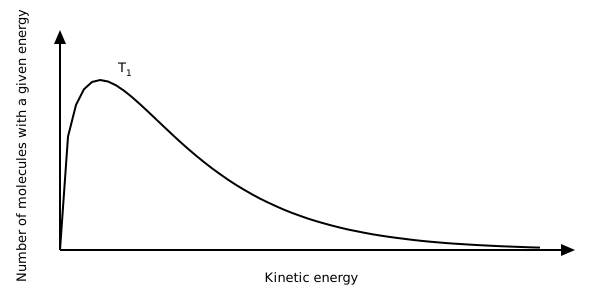
(iii) The Maxwell–Boltzmann distribution below shows the kinetic energies of the reactant molecules at temperature T1. Sketch a second curve for the same sample at a higher temperature.
 Powiększ
(iv) Use the two curves, annotated with the activation energy, to explain why raising the temperature increases the rate of the hydrolysis.
(v) A student claims that a certain solid catalyses the hydrolysis. Describe two observations that would support this claim.
Korepetytor AI
Nie wiesz, jak ruszyć? Korepetytor zna to zadanie i poprowadzi Cię krok po kroku, bez gotowca.
3 rozmowy · bez karty · Zaloguj się
Sprawdź się
Odpowiedz i oceń, jak poszło. Klucz odsłoń dopiero, gdy masz swoją odpowiedź.
Zanim porównasz z kluczem
Jak poszło Ci z tym zadaniem?
Zaloguj się, żeby zapisać ocenę i wrócić do zadania później.
Pokaż rozwiązanieUkryj rozwiązanieKlucz i punktacja
Odpowiedź z klucza
(i) measure the change in pressure per unit time at constant volume «2 mol of gas become 3 mol»
OR
measure the change in volume per unit time at constant pressure ✔
(ii) the molecules may collide with an unsuitable orientation ✔
the collision energy may be less than the activation energy ✔
(iii) second curve starting at the origin with a lower maximum displaced to higher energy, staying above the axis at high energy «area under both curves the same» ✔
(iv) Ea marked as a vertical line on the energy axis ✔
at the higher temperature a greater proportion of molecules have energy equal to or greater than Ea «larger area under the curve to the right of Ea», so a greater fraction of collisions are successful ✔
(v) the solid is chemically unchanged / its mass is unchanged at the end of the reaction ✔
the rate of reaction is greater in its presence «under otherwise identical conditions» ✔
Schemat punktowania
(i) [1] a physical change that follows the increase in the amount of gas; do not accept pH measurement or titration. (ii) [2] M1 orientation; M2 energy below Ea. (iii) [1] no mark if the curve does not start at the origin, crosses the axis or has a larger area. (iv) [2] M1 Ea indicated; M2 greater proportion of molecules with E ≥ Ea. (v) [2] M1 unchanged at the end; M2 rate increased. Answers that only quote the definition of a catalyst without an observation do not score.