Zadanie 3c
Wzorowane na: Chemistry HL Paper 2, November 2023, TZ1, pytanie 3(c). Treść, dane i kontekst są zmienione; sprawdzane umiejętności, format i punktacja jak w oryginale.
Darmowe konto pozwoli wrócić do niego później.
Informacja do zadań 3a-3d.
Ethanoic acid can be converted into the ester CH3COOCH3 by heating it with a second reagent in the presence of an acid catalyst.
Polecenie
Spectra can be used to monitor the conversion of ethanoic acid into the ester.
(i) State one similarity and one difference between the infrared (IR) spectra of ethanoic acid and of the ester in the 1500–3500 cm−1 region. Use section 20 of the data booklet.
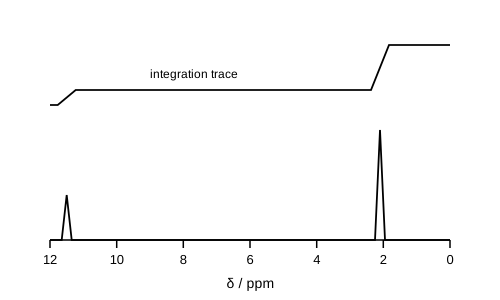
(ii) The 1H NMR spectrum of one of the two compounds is shown with its integration trace. Using the integration trace, deduce which compound, ethanoic acid or the ester, gave the spectrum.
Sprawdź rozwiązanieUkryj rozwiązanieKlucz i punktacja
Odpowiedź z klucza
(i) Similarity: absorption at 1700–1750 cm−1 «by the C=O bond» ✔
OR
absorption at 2850–3090 cm−1 «by the C–H bond» ✔
Difference: only ethanoic acid shows the very broad «O–H» absorption at 2500–3000 cm−1 ✔
(ii) ethanoic acid AND the ratio of the areas under the signals / of the steps is 3 : 1 «the ester would give 1 : 1» ✔
Schemat punktowania
(i) M1 similarity, M2 difference; the bond must be linked to a wavenumber or to the spectrum. Do not accept the C–O absorption at 1050–1410 cm−1 as it is outside the range. Do not accept 3200–3600 cm−1 for the acid O–H. (ii) [1] for ethanoic acid with the ratio 3 : 1 (OR the signal of 3 H : 1 H). An answer based only on chemical shift earns no mark.