Zadanie 5e
Wzorowane na: Chemistry HL Paper 2, November 2023, TZ1, pytanie 5(e). Treść, dane i kontekst są zmienione; sprawdzane umiejętności, format i punktacja jak w oryginale.
Darmowe konto pozwoli wrócić do niego później.
Informacja do zadań 5a-5h.
Aluminium has a low density, which is why it is widely used in aircraft and in specialized alloys.
Polecenie
Manganese, unlike aluminium, is a transition element.
(i) Deduce, from the electron configuration of the Mn2+ ion, why manganese is classified as a transition element.
(ii) The first four ionization energies of aluminium and manganese are shown.
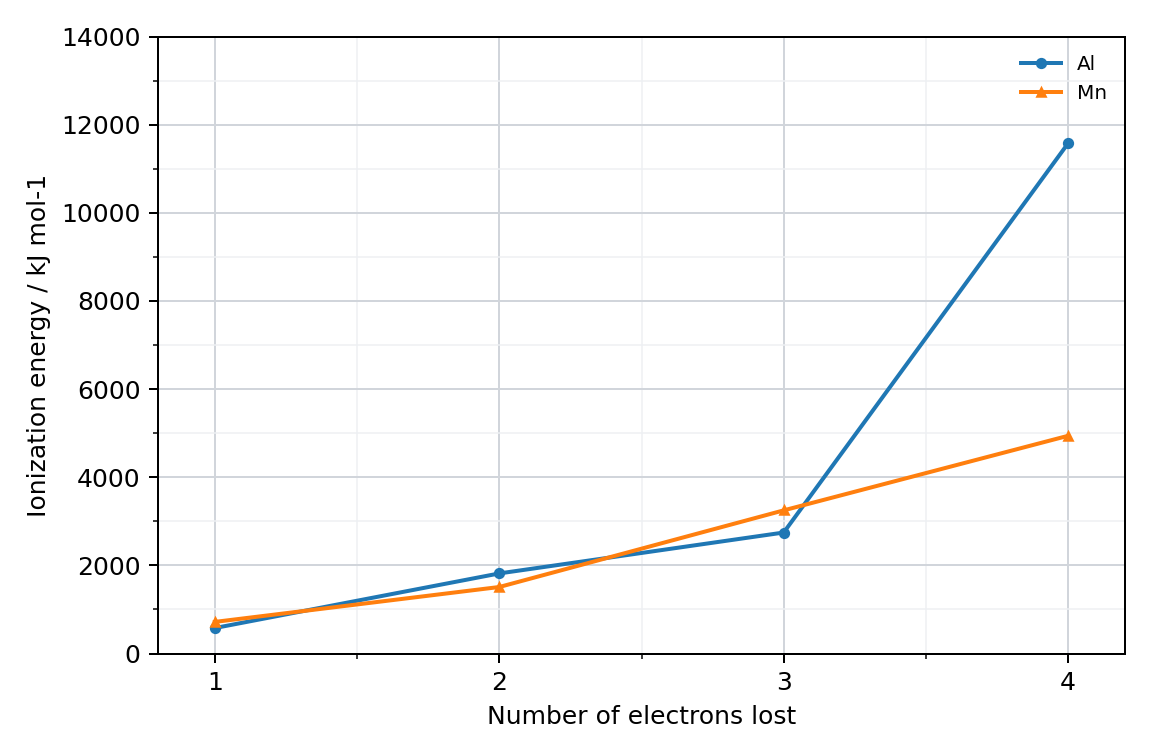
One common property of transition elements is that they have variable oxidation states. Discuss, referring to the graph, why manganese, but not aluminium, displays this characteristic.
Sprawdź rozwiązanieUkryj rozwiązanieKlucz i punktacja
Odpowiedź z klucza
(i) Mn2+: 1s2 2s2 2p6 3s2 3p6 3d5 «[Ar] 3d5», so its ion has an incomplete d sub-level ✔
(ii) the ionization energies of manganese increase gradually AND those of aluminium show a sudden / large rise between the third and fourth ✔
aluminium has only three easily removed electrons «the fourth must come from an inner shell», so it forms only the +3 oxidation state ✔
the successive ionization energies of manganese are close together, so manganese can lose different numbers of electrons depending on the oxidizing agent present ✔
Schemat punktowania
(i) [1] for the configuration with a partially filled d sub-level; accept [Ar]3d5. (ii) M1: gradual rise for manganese AND sudden rise for aluminium; M2: aluminium forms only +3 / three valence electrons; M3: close ionization energies allow different numbers of electrons to be lost by manganese. Accept “aluminium always loses three electrons” for M2.