Zadanie 3d, Paper 2, listopad 2025, TZ3, Chemia IB HL
Wzorowane na: Chemistry HL Paper 2, November 2025, TZ3, pytanie 3(d). Treść, dane i kontekst są zmienione; sprawdzane umiejętności, format i punktacja jak w oryginale.
Darmowe konto pozwoli wrócić do niego później.
Zadanie
Wspólne informacje do wiązki zadań
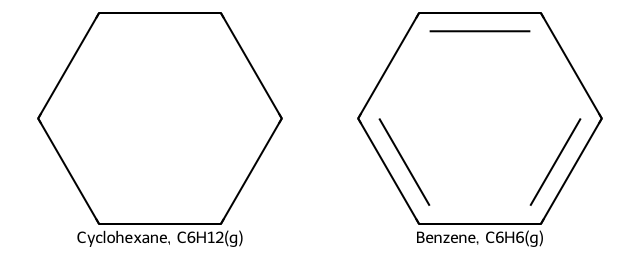
In industry, benzene can be formed from cyclohexane through a gas-phase equilibrium reaction.
C6H12(g) ⇌ C6H6(g) + 3 H2(g)
 Powiększ
Polecenie
The forward reaction is first order with respect to cyclohexane.
C6H12(g) ⇌ C6H6(g) + 3 H2(g)
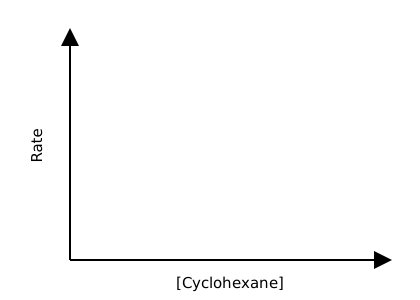
(i) Sketch a graph showing how the rate varies with the concentration of cyclohexane.
 Powiększ
(ii) Deduce the reaction's rate equation, and state the units of the rate constant k.
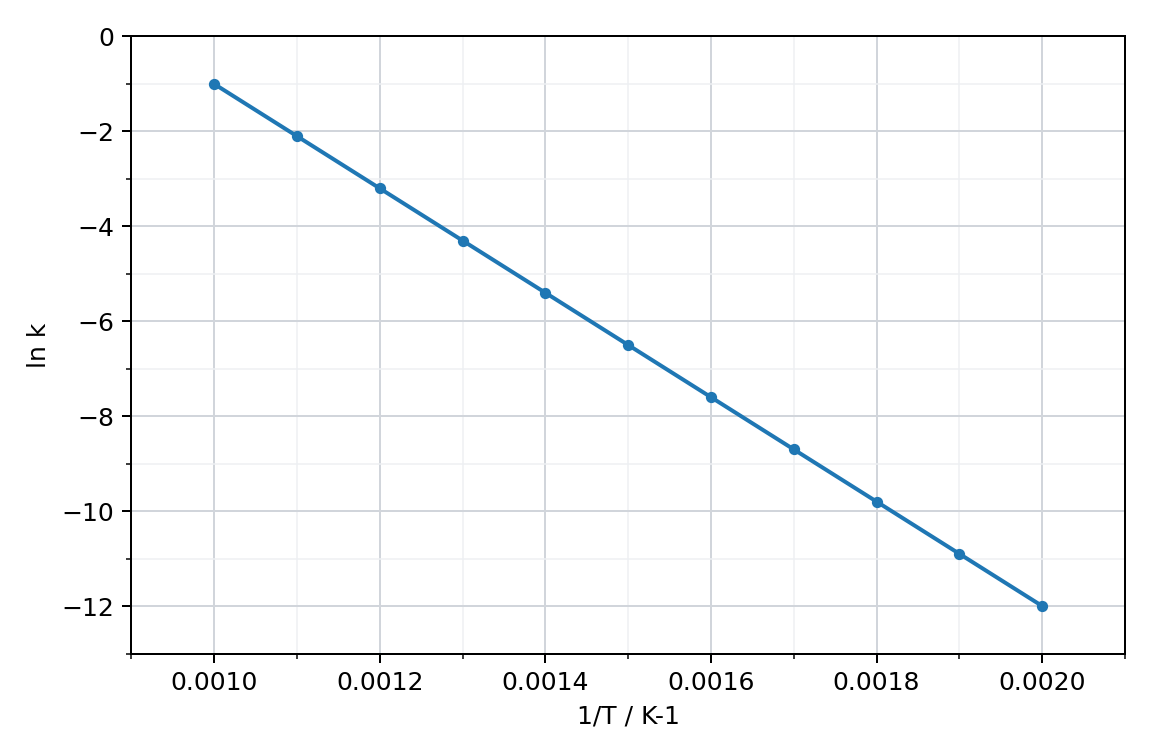
(iii) Using the Arrhenius plot and sections 1 and 2 of the data booklet, determine the reaction's activation energy, Ea, in kJ mol−1.
 Powiększ
Korepetytor AI
Nie wiesz, jak ruszyć? Korepetytor zna to zadanie i poprowadzi Cię krok po kroku, bez gotowca.
3 rozmowy · bez karty · Zaloguj się
Sprawdź się
Odpowiedz i oceń, jak poszło. Klucz odsłoń dopiero, gdy masz swoją odpowiedź.
Zanim porównasz z kluczem
Jak poszło Ci z tym zadaniem?
Zaloguj się, żeby zapisać ocenę i wrócić do zadania później.
Pokaż rozwiązanieUkryj rozwiązanieKlucz i punktacja
Odpowiedź z klucza
(i) straight line through the origin «with a positive gradient» ✔
(ii) Rate equation: «rate =» k[C6H12] ✔
Units of k: s−1 ✔
(iii) gradient «» = −1.1 × 10⁴ «K» ✔
«Ea = −gradient × R = 1.1 × 104 × 8.31 = 91 000 J mol−1 =» 91 «kJ mol−1» ✔
Schemat punktowania
(i) [1]. (ii) [1] for the rate equation, [1] for the units. (iii) M1: gradient in the range −1.05 × 10^4 to −1.15 × 10^4 K; M2: Ea in the range 87–96 kJ mol-1. Award [2] for a correct final answer. Award [1 max] for −91 kJ mol-1. Do not accept Ea given in J mol-1.
Komentarz. Ea = −gradient × R with the gradient in kelvin; the answer is required in kJ mol-1, so divide by 1000.