Zadanie 5c, Paper 2, listopad 2025, TZ3, Chemia IB HL
Wzorowane na: Chemistry HL Paper 2, November 2025, TZ3, pytanie 5(c). Treść, dane i kontekst są zmienione; sprawdzane umiejętności, format i punktacja jak w oryginale.
Darmowe konto pozwoli wrócić do niego później.
Zadanie
Wspólne informacje do wiązki zadań
The relative abundances of the two isotopes in a sample of chlorine are shown below.
| Isotope | Relative abundance / % |
|---|---|
| 75.50 | |
| 24.50 |
Polecenie
(i) Using sections 9 and 17 of the data booklet, and showing your working, deduce the type of bonding present in magnesium chloride, MgCl2, and its percentage covalent character.
(ii) Assuming purely ionic bonding, and using sections 9 and 12 of the data booklet together with the following data, determine the lattice enthalpy of magnesium chloride:
Enthalpy of formation of magnesium chloride = −641 kJ mol−1
Second ionization energy of magnesium = +1451 kJ mol−1
Enthalpy of atomization of magnesium = +148 kJ mol−1
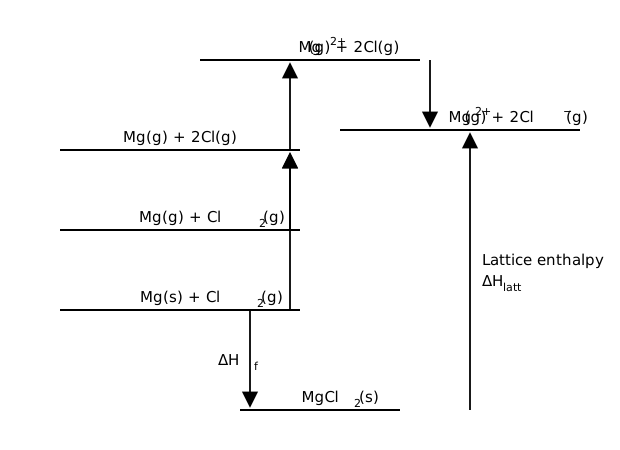 Powiększ
(iii) Using section 10 of the data booklet, explain, with reference to electron structure, why the period 3 ions Na+, Mg2+ and Cl− have different ionic radii.
(iv) Giving a reason, predict whether calcium chloride, CaCl2, or magnesium chloride has the stronger ionic bonding.
Korepetytor AI
Nie wiesz, jak ruszyć? Korepetytor zna to zadanie i poprowadzi Cię krok po kroku, bez gotowca.
3 rozmowy · bez karty · Zaloguj się
Sprawdź się
Odpowiedz i oceń, jak poszło. Klucz odsłoń dopiero, gdy masz swoją odpowiedź.
Zanim porównasz z kluczem
Jak poszło Ci z tym zadaniem?
Zaloguj się, żeby zapisać ocenę i wrócić do zadania później.
Pokaż rozwiązanieUkryj rozwiązanieKlucz i punktacja
Odpowiedź z klucza
(i) «electronegativity difference = 3.2 − 1.3 =» 1.9 AND «average electronegativity = (3.2 + 1.3)/2 =» 2.25 / 2.3 ✔
ionic AND «approximately» 40 % covalent ✔
(ii) three values from the data booklet: «Cl–Cl bond enthalpy» 242 AND «first ionization energy of Mg» 738 AND «electron affinity of Cl» −349 «kJ mol⁻¹» ✔
«2 × (−349) =» −698 «kJ mol⁻¹» ✔
641 + 148 + 738 + 1451 + 242 = ΔHlatt + 698 AND «ΔHlatt = 3220 − 698 = +2522 =» +2520 «kJ mol⁻¹» ✔
(iii) Na+ and Mg2+ have lost their 3s electrons / have electrons in only 2 shells / energy levels «[Ne], so both are smaller than Cl−» ✔
Mg2+ has a greater nuclear charge / more protons than Na+ «12 compared with 11, so the same electrons are pulled closer: 72 pm compared with 102 pm» ✔
Cl− has electrons in 3 shells / energy levels / 3p⁶ «so it is the largest, 181 pm» ✔
(iv) magnesium chloride AND «Mg2+ has a» smaller radius / higher charge density «than Ca2+» ✔
Schemat punktowania
(i) M1: both electronegativity quantities from section 9; M2: ionic with a percentage covalent character in the range 35–45 %. (ii) M1: the three booklet values; M2: the electron affinity doubled; M3: correct application of Hess's law and the lattice enthalpy, +2520 kJ mol-1. Award [3] for the correct final answer; award [2 max] for −2520 kJ mol-1. M1 and M2 may be scored on the diagram. ECF for M3 from the candidate's own values. (iii) [1] for each point. (iv) [1] for magnesium chloride with the reason.
Komentarz. The electron affinity of chlorine is counted twice because two Cl− ions are formed per formula unit; the experimental value in section 16 (2540 kJ mol-1) is close to the purely ionic estimate.