Zadanie 4c, Paper 2, listopad 2025, TZ3, Chemia IB HL
Wzorowane na: Chemistry HL Paper 2, November 2025, TZ3, pytanie 4(c). Treść, dane i kontekst są zmienione; sprawdzane umiejętności, format i punktacja jak w oryginale.
Darmowe konto pozwoli wrócić do niego później.
Zadanie
Wspólne informacje do wiązki zadań
Reacting ethene, C2H4, with hydrogen iodide, HI, produces iodoethane, C2H5I.
C2H4(g) + HI(g) → C2H5I(l)
Polecenie
Iodoethane can react with aqueous hydroxide ions to produce ethanol.
CH3CH2I(l) + OH−(aq) → CH3CH2OH(aq) + I−(aq)
(i) State what type of reaction this is.
(ii) Using curly arrows to show the movement of electron pairs, sketch the mechanism of this reaction.
(iii) Outline why this mechanism is the one followed.
(iv) State this reaction's order.
(v) Giving a reason, predict a halogenoethane that reacts more slowly than iodoethane does.
(vi) The NMR spectrum of iodoethane shows two signals. Deduce the splitting pattern of the signal produced by the CH3 protons.
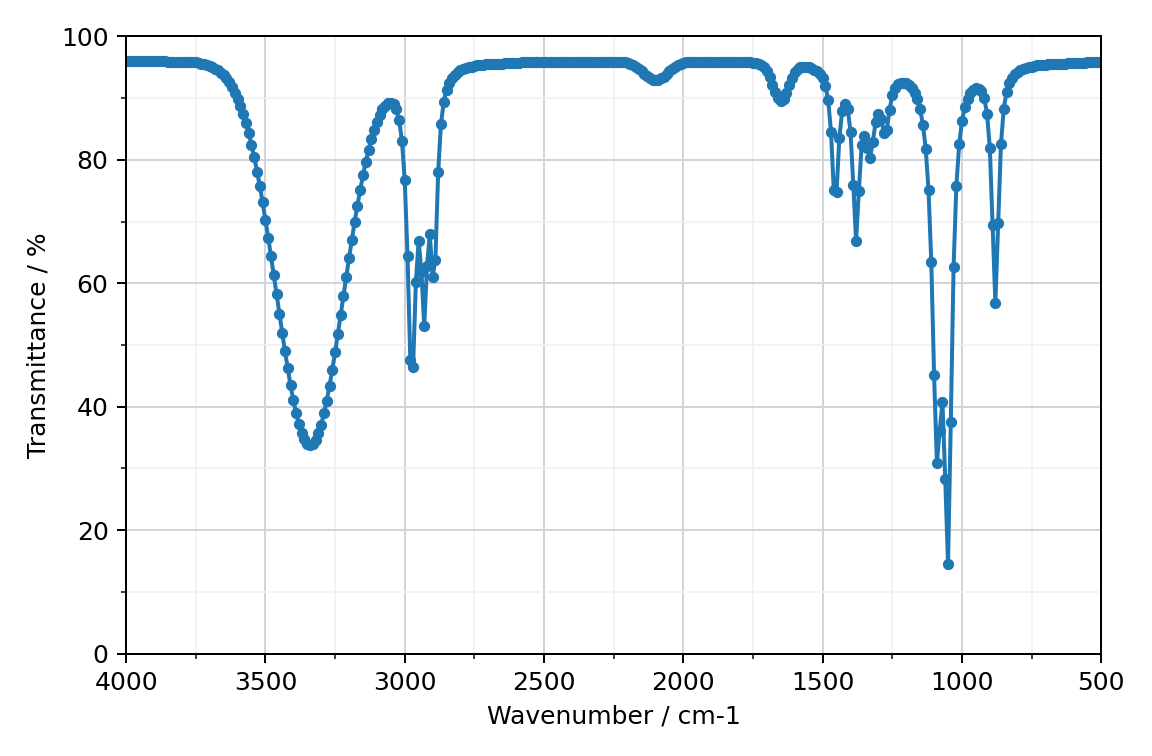
(vii) Using evidence from section 20 of the data booklet, deduce whether iodoethane or ethanol produced the infrared spectrum below.
 Powiększ
Korepetytor AI
Nie wiesz, jak ruszyć? Korepetytor zna to zadanie i poprowadzi Cię krok po kroku, bez gotowca.
3 rozmowy · bez karty · Zaloguj się
Sprawdź się
Odpowiedz i oceń, jak poszło. Klucz odsłoń dopiero, gdy masz swoją odpowiedź.
Zanim porównasz z kluczem
Jak poszło Ci z tym zadaniem?
Zaloguj się, żeby zapisać ocenę i wrócić do zadania później.
Pokaż rozwiązanieUkryj rozwiązanieKlucz i punktacja
Odpowiedź z klucza
(i) nucleophilic substitution / SN2 ✔
(ii) curly arrow from the lone pair / negative charge on O of HO− to the carbon atom bonded to iodine ✔
curly arrow from the C–I bond to the I atom ✔
transition state showing the negative charge AND partial «dotted» bonds from O to C and from C to I «in square brackets, with HO and I on opposite sides of the carbon» ✔
(iii) primary halogenoalkane «little steric hindrance; a primary carbocation would be too unstable for SN1» ✔
(iv) 2 / second «order» ✔
(v) chloroethane / bromoethane AND the C–Cl / C–Br bond is stronger / harder to break «than C–I»
OR
chloroethane / bromoethane AND Cl− / Br− is a poorer leaving group ✔
(vi) triplet / 3 «peaks, because the neighbouring CH2 group has two protons» ✔
(vii) ethanol AND presence of a broad O–H absorption in the 3200–3600 «cm⁻¹» range
OR
ethanol AND presence of a C–O absorption in the 1050–1410 «cm⁻¹» range
OR
ethanol AND absence of a C–I absorption in the 490–620 «cm⁻¹» range ✔
Schemat punktowania
(i) [1]; accept SN2, do not accept SN1. (ii) M1: curly arrow from the lone pair or charge of the nucleophile to carbon; M2: curly arrow from the C–I bond to iodine, in iodoethane or in the transition state; M3: transition state with a negative charge and both partial bonds. Award [2 max] for a correct SN1 mechanism if SN1 was not stated in (i). Do not award M3 if a full HO–C bond is drawn while the C–I bond is still present. (iii) [1]; accept a reason such as lack of steric hindrance or the instability of a primary carbocation. (iv) [1]. (v) [1] for the halogenoethane with a bond-strength or leaving-group reason. (vi) [1]. (vii) [1] for ethanol with one piece of evidence; accept a specific wavenumber within the quoted ranges.