Zadanie 3f, Paper 2, listopad 2025, TZ3, Chemia IB HL
Wzorowane na: Chemistry HL Paper 2, November 2025, TZ3, pytanie 3(f). Treść, dane i kontekst są zmienione; sprawdzane umiejętności, format i punktacja jak w oryginale.
Darmowe konto pozwoli wrócić do niego później.
Zadanie
Wspólne informacje do wiązki zadań
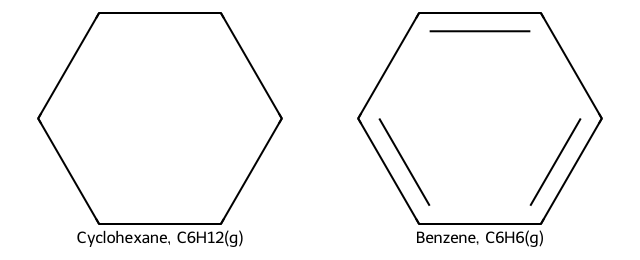
In industry, benzene can be formed from cyclohexane through a gas-phase equilibrium reaction.
C6H12(g) ⇌ C6H6(g) + 3 H2(g)
 Powiększ
Polecenie
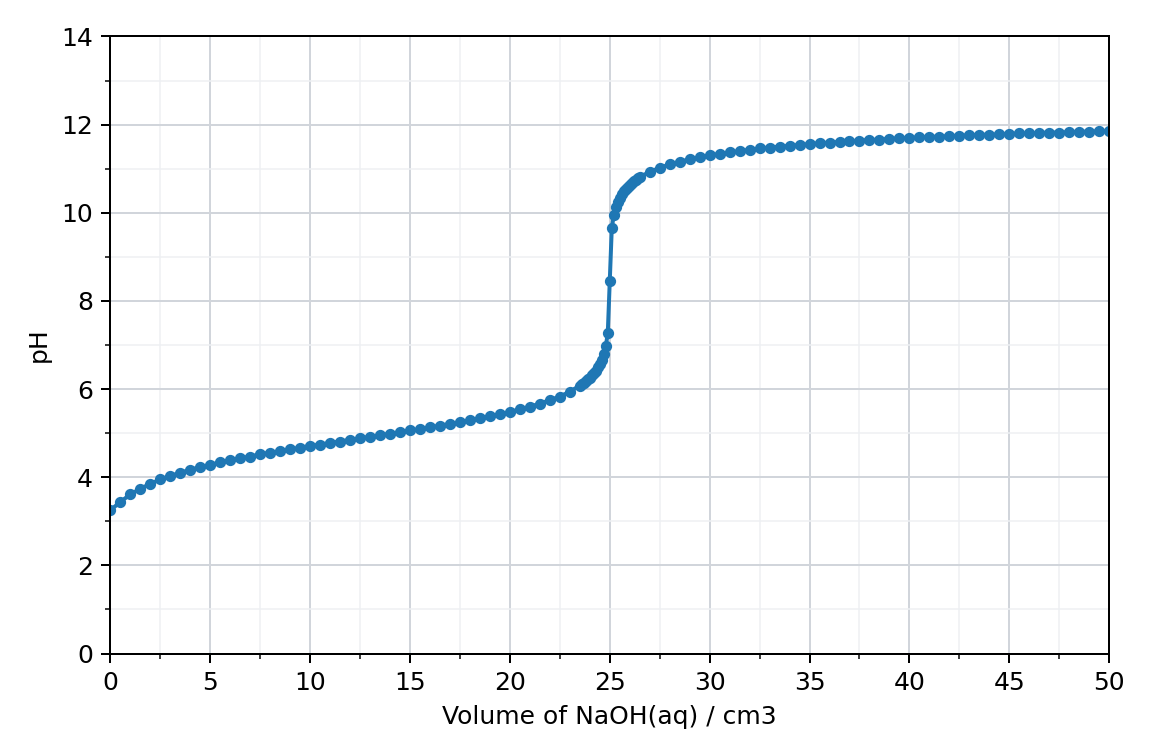
Hexanoic acid, CH3(CH2)4COOH, is a weak acid. The graph shows how the pH changes during the titration of a 20.0 cm3 aqueous solution of hexanoic acid with aqueous sodium hydroxide.
 Powiększ
(i) Deduce an expression for the equilibrium constant, K, of the ionization of hexanoic acid.
(ii) By annotating the graph, find the pKa of hexanoic acid.
(iii) Using section 18 of the data booklet, suggest a suitable indicator for this titration.
(iv) With reference to acid–base equilibria, explain why the resulting sodium hexanoate solution has a pH greater than 7.
(v) Given that the sodium hydroxide concentration was 0.020 mol dm−3, calculate the concentration, in mol dm−3, of the hexanoic acid solution.
Korepetytor AI
Nie wiesz, jak ruszyć? Korepetytor zna to zadanie i poprowadzi Cię krok po kroku, bez gotowca.
3 rozmowy · bez karty · Zaloguj się
Sprawdź się
Odpowiedz i oceń, jak poszło. Klucz odsłoń dopiero, gdy masz swoją odpowiedź.
Zanim porównasz z kluczem
Jak poszło Ci z tym zadaniem?
Zaloguj się, żeby zapisać ocenę i wrócić do zadania później.
Pokaż rozwiązanieUkryj rozwiązanieKlucz i punktacja
Odpowiedź z klucza
(i) ✔
(ii) horizontal line drawn from the point on the curve at 12.5 cm3 of NaOH «half the equivalence volume» to the pH axis, giving pKa ≈ 4.9 ✔
(iii) phenolphthalein
OR
phenol red
OR
bromothymol blue ✔
(iv) «hexanoate ion» hydrolyses / reacts with water AND forms OH−
OR
CH3(CH2)4COO−(aq) + H2O(l) ⇌ CH3(CH2)4COOH(aq) + OH−(aq) ✔
(v) «n(NaOH) = 0.0250 × 0.020 = 5.0 × 10⁻⁴ mol = n(acid)» «» 0.025 «mol dm−3» ✔
Schemat punktowania
(i) [1]; accept H3O+ for H+ and Ka for K. (ii) [1] for a line from the half-equivalence point (12.5 cm3) to the pH axis; accept an intersection between pH 4.7 and 5.0. (iii) [1] for any indicator whose range lies within the steep part of the curve, roughly pH 6.5–10.5. (iv) [1]; the equation alone scores. (v) [1].
Komentarz. At half the equivalence volume [HA] = [A−], so pH = pKa; the equivalence point of a weak acid with a strong base lies above pH 7, which rules out methyl orange and methyl red.